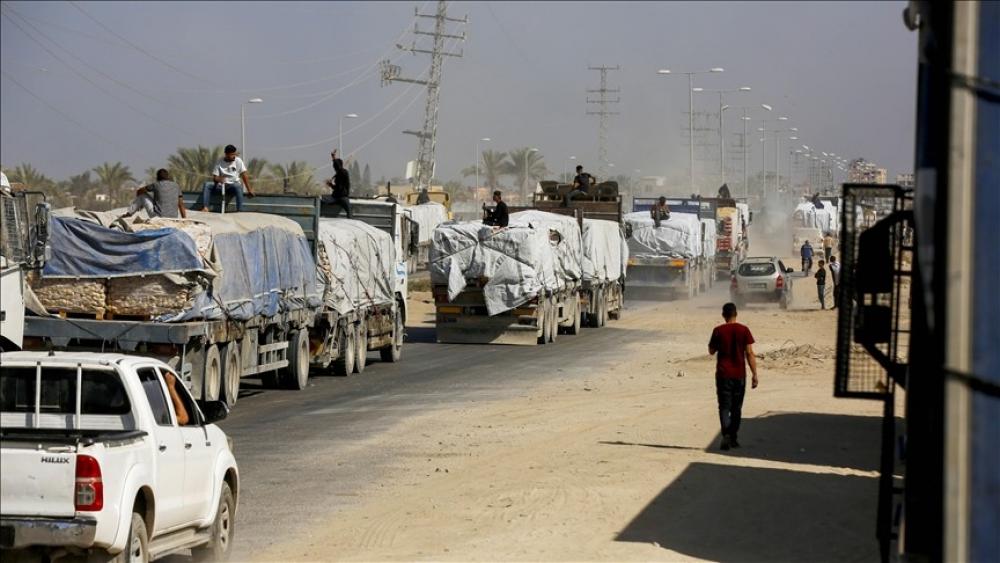
A spokesperson for the UN Office for the Coordination of Humanitarian Affairs (OCHA), Jens Laerke, on Friday stressed the urgent need to allow unrestricted entry of essential supplies into the Gaza Strip, as Israeli obstacles to humanitarian aid continue despite the launch of the second phase of the ceasefire.
Laerke made the remarks in an interview with Anadolu Agency, commenting on the announcement by U.S. Middle East envoy Steve Witkoff that the second phase of the Gaza agreement had begun, the effectiveness of the ceasefire—now in place for nearly three months—in facilitating aid delivery, and expectations for the next stage.
He said the announcement of the second phase represents an important step from the UN’s perspective, noting that any initiative that helps ease civilian suffering, supports reconstruction, and opens a credible political horizon is viewed positively.
Laerke pointed to what he described as meaningful progress during the first three months of the ceasefire. “For example, humanitarian partners have reopened 36 health facilities and established 26 new ones, and we continue to distribute shelter assistance to those in need across Gaza,” he said.
However, he emphasized that major obstacles to the entry of additional humanitarian aid remain in place, adding that removing these barriers is critical. “We need to bring vital materials into Gaza without restrictions, including timber, plywood, cement, and essential tools to reinforce shelters and repair homes,” Laerke said.
He also highlighted the need for heavy equipment to remove debris and break up rubble, water pumps to drain rainwater and prevent flooding, and sandbags, noting that thousands of Palestinians have continued to be affected by recent winter storms.
Although the ceasefire agreement came into effect on October 10, 2025, bringing an end to the genocide, living conditions have seen little improvement. This, according to observers, is due to Israel’s failure to meet its obligations under the agreement, including allowing in the agreed quantities of food, relief and medical supplies, mobile housing units, and fully opening border crossings.
On Wednesday, Witkoff formally announced the start of the second phase of the Gaza ceasefire process.
Since October 7, 2023, Israel’s war on Gaza—backed by the United States—has killed more than 71,000 Palestinians and wounded 171,000 others, most of them women and children. The assault has devastated nearly 90 percent of Gaza’s civilian infrastructure, with the United Nations estimating reconstruction costs at around $70 billion.
Shortlink for this post: https://daysofpalestine.ps/?p=71363