DaysofPal – In the shadow of a healthcare system pushed to the brink of collapse, the stories of nine-month-old Omar Abu Youssef and six-month-old Mais Muammar serve as a haunting microcosm of a much larger tragedy. They are two of thousands of children in the Gaza Strip whose lives are currently suspended between the walls of an intensive care unit and the uncertainty of a displacement tent, trapped by a blockade that has turned life-saving medicine into a distant luxury.
Omar: A Rare Battle for Survival
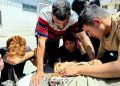
For nine-month-old Omar, life has never known the comfort of home, only the sterile, under-equipped halls of a hospital. Born with a congenital intestinal obstruction, Omar’s first days were defined by emergency surgery to create a stoma, a surgical opening in the abdomen to allow waste to exit the body.
However, his condition is far more complex than a standard obstruction. Subsequent tests revealed a rare neurological complication: a total absence of nerve cells in the rectum, while they remain present in the stoma area. The results have been catastrophic.
Without the ability to process waste normally, Omar’s tiny body began expelling waste through his nose, a rare and dangerous medical phenomenon that has led to severe fluid loss and looming kidney failure.
“My son’s suffering doesn’t stop,” his mother told journalist Amr Tabsh. “He is losing fluids faster than we can replace them.”
Despite his critical state, doctors in Gaza are paralyzed. The acute shortage of diagnostic tools and specialized surgical equipment means they can do little more than stabilize him. For Omar, the only hope is a medical referral abroad, an exit strategy currently blocked by closed crossings.
Mais: The Fragile Cost of War
A few miles away, at the Nasser Medical Hospital in Khan Yunis, six-month-old Mais Muammar is fighting a battle on three fronts: congenital illness, malnutrition, and the aftermath of siege.
Born weighing a mere 1.4 kilograms (approx. 3 lbs), Mais is a victim of the “starvation reality” that plagued Gaza during her mother’s pregnancy. She was born with Down syndrome, a hole in her heart, and a solitary kidney afflicted by stones.
“People in Gaza are literally dying because of a lack of medicine,” says her father, Murad, as he watches the monitors tracking his daughter’s frail heartbeat.
A Healthcare System Under Siege
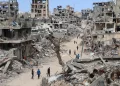
The plight of Omar and Mais is not an isolated incident. According to the Gaza Ministry of Health, the systematic targeting of medical facilities and the ongoing closure of crossings have left the health sector in a state of “unprecedented exhaustion.”
According to Gaza’s Ministry of Health, these closures have caused severe shortages in over half of essential medicines and nearly 70% of medical supplies. Hospitals have been forced to prioritize only “life-saving” cases, leaving hundreds of patients, particularly children, without diagnosis or treatment.
Dr. Mohammed Abed, head of the pediatric ICU at Nasser Hospital, explains that even when children like Mais are granted official medical referrals, the documents remain “ink on paper” because the borders remain sealed. “We cannot provide basic services, sufficient tests, or even the most vital drugs,” he warns.
Despite a ceasefire agreement in October 2025, the humanitarian relief entering the Strip remains a fraction of what is required, less than 25% of the actual need. Organizations like Doctors Without Borders (MSF) and the World Health Organization (WHO) warn that the death toll of those waiting for evacuation is likely much higher than official records suggest.
While countries like Egypt and the UAE have accepted some patients, the scale of the crisis dwarfs the current international response.
For Omar and Mais, time is the one resource they do not have. Their accounts serve as a somber reminder that a ceasefire is merely the beginning for the children of Gaza. The “waiting room” of the Gaza Strip will remain a place where lives and hope are lost unless the borders are immediately opened for medical assistance and evacuations.
Shortlink for this post: https://daysofpalestine.ps/?p=71019