DaysofPal- The Israeli occupation ranked last worldwide in the 2025 Global Nation Brands Index for the second consecutive year, underscoring a sharp decline in its international standing amid the ongoing genocidal war on Gaza, expanding boycott campaigns, and growing diplomatic isolation.
The findings were published in the latest Anholt Nation Brands Index, an annual global survey compiled by nation-branding expert Simon Anholt, and were reported by Israel’s economic daily Globes.
The survey indicated that the deterioration in the Israeli image extended beyond perceptions of the state to include views of Israeli society as a whole.
According to the report, the Israeli occupation’s continued decline followed its military campaign in the Gaza Strip, which Palestinian sources have described as a genocide that has killed more than 70,000 Palestinians, most of them women and children.
The war coincided with intensified international criticism, widening boycott efforts, and a noticeable erosion of political support, particularly in Europe, throughout 2025.
Although the Israeli occupation initially received broad international backing following the October 7, 2023 attack, especially from Western governments and the United States, that support gradually weakened as the scale of destruction and civilian casualties in Gaza became increasingly visible.
European positions shifted markedly as the war continued. On May 20, 2025, the European Union’s High Representative announced the launch of a review of the EU–Israeli Association Agreement, the central framework governing political and economic relations between the two sides.
Economic pressure also intensified. In August 2025, Norway’s sovereign wealth fund, the world’s largest, announced it would divest from five major Israeli banks.
Earlier that year, the fund had withdrawn from 23 Israeli companies and sold Israeli bonds worth about $500 million, citing growing concerns over political and economic risk.
In October, Dutch pension fund ABP said it had sold its entire €387 million stake in Caterpillar, following earlier divestments in companies including Motorola, Teva, Coca-Cola (U.S.), and Booking Holdings.
The technology sector was also affected. Samsung’s venture capital arm, Samsung Next, shut down its Tel Aviv operations in April 2025, while Intel closed the Israeli startup Granulate, acquired for $650 million, after failing to find a buyer, citing heightened risk surrounding occupation-linked assets.
Boycott efforts expanded within academic institutions, whereas in October 2025, staff at Canada’s McGill University voted overwhelmingly to adopt an academic and cultural boycott of the Israeli occupation, including ending research partnerships with Israeli universities.
In the United States, student unions passed similar resolutions, including a landmark vote at the University of Maryland, reflecting growing campus activism.
Despite continued U.S. military and political support, criticism within the United States intensified. Opinion polls showed rising Democratic support for reducing military aid to the Israeli occupation, while Republican backing also declined.
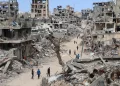
Analysts cited widespread circulation of images showing destruction, civilian casualties, and humanitarian suffering in Gaza as key
Israeli affairs analyst Amin Al-Hajj described 2025 as a year dominated by “defense and justification,” saying the Israeli diplomatic and media efforts struggled to contain mounting scrutiny.
He noted that while the Israeli occupation has not lost all international support, its legitimacy has weakened, with public opinion in both the Global South and parts of the Global North turning increasingly critical.
According to Al-Hajj, repeated votes against the Israeli occupation in international forums and symbolic moments, such as sparse attendance during Israeli leaders’ speeches at the United Nations, reflect a deepening sense of isolation and a widening gap between official support and global public sentiment.
Shortlink for this post: https://daysofpalestine.ps/?p=70935