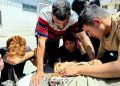
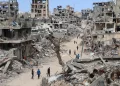
Gaza City – The Islamic University of Gaza has resumed on-site classes for the first time in two years, reopening its shattered campus to students even as it serves as a refuge for hundreds of displaced families.
The university, which began partially operating again following an October ceasefire, now hosts about 500 displaced families living inside buildings that have been largely gutted by Israeli bombardment.
Tents now fill the spaces where lecture halls and courtyards once stood, symbolising the overlapping crises of mass displacement and the near-collapse of Gaza’s education system.
“We came here after being displaced from Jabalia because we had nowhere else to go,” said Atta Siam, who is sheltering on campus with his family.
“But this place is for education. It’s not meant to be a shelter – it’s a place for our children to study.” Siam said.
The return to limited in-person learning has offered a rare glimmer of hope to thousands of students, despite conditions far removed from a functioning university.
UNESCO estimates that more than 95 percent of higher education institutions in Gaza have been severely damaged or destroyed since the Israeli occupation launched its genocidal war in October 2023.
In January, the Gaza-based Al Mezan Center for Human Rights reported that 494 schools and universities had been partially or completely destroyed, including 137 reduced entirely to rubble.
The group also documented the killing of 12,800 students, 760 teachers and education workers, and 150 academics and researchers.
Isra University, the last fully functioning university in Gaza, was demolished by Israeli forces in January 2024.
Human rights organizations and UN experts have described the pattern of attacks on Gaza’s education sector as “scholasticide”, the systematic destruction of an entire education system.
More than 750,000 Palestinian students have now gone without formal schooling for two consecutive academic years, according to Al Mezan.
Inside the Islamic University, staff and students are attempting to rebuild academic life with minimal infrastructure.
Power cuts, a lack of equipment and damaged facilities have forced lecturers to improvise.
“We’ve borrowed motors to generate electricity to operate the university equipment,” said Dr Adel Awadallah, a member of the teaching staff, describing how exposed walls are being covered with plastic sheets so more students can fit into the few usable spaces.
Only four classrooms are currently operational, serving thousands of students, he added.
First-year medical student Youmna Albaba said she had long dreamt of studying at a fully equipped campus.
“I need a place where I can focus, that is fully qualified in every way,” Albaba said.
“But I haven’t found what I imagined here. Still, I have hope because we are building everything from scratch.” She added.
UN experts warned in April 2024 that the scale and pattern of destruction of schools and universities in Gaza may amount to a deliberate attempt to dismantle the foundations of Palestinian society.
“When schools are destroyed, so too are hopes and dreams,” they said in a joint statement, condemning what they called systematic attacks on educational infrastructure.
The struggle to restore education goes far beyond damaged buildings. Families are contending with severe shortages of food, clean water, medicine and basic supplies, leaving many unable to support their children’s learning.
Remote classes organised by the Ministry of Education and UNRWA have been repeatedly disrupted by electricity blackouts, internet outages and the constant displacement of families fleeing violence.
Despite the trauma of more than two years of bombardment and widespread loss of life, many students continue to list returning to school as one of their highest priorities, seeing it as a path back to normalcy and a future beyond the war.
“Despite all this, I am happy because I attend lectures in person,” Albaba said.
“We are building everything from scratch.” She concluded.
Shortlink for this post: https://daysofpalestine.ps/?p=70567