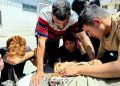
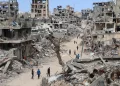
DaysofPal- Palestinian officials have stated that the Israeli occupation is deliberately sabotaging Gaza’s efforts to rebuild its shattered health system, warning that the enclave faces “a humanitarian collapse” nearly a month after the ceasefire agreement signed in Sharm El-Sheikh.
During a press conference outside al-Awda Health Center in Nuseirat on Sunday, officials urged international mediators, particularly Egypt, Qatar, Turkey, and the United States, to pressure the Israeli occupation into fully implementing the truce’s humanitarian clauses.
They said ongoing restrictions on aid and movement continue to endanger the lives of more than 2.3 million Palestinians living in Gaza’s ruins.
Under the humanitarian annex of the January 2025 framework, the Israeli occupation was required to allow 600 trucks of aid into Gaza daily through UN agencies, international organizations, and the private sector. The shipments were to include food, medicine, shelter materials, fuel, and cooking gas.
However, according to Gaza’s government media office, only 3,203 trucks entered the enclave between October 10 and 31, averaging just 145 per day, or 24% of the agreed amount.
“The humanitarian and health situation continues to deteriorate on all fronts,” said Amjad al-Shawa, Director of the Palestinian NGOs Network.
“Three weeks after the ceasefire, Gaza remains on the brink. The Israeli occupation still controls more than half of the territory, and hundreds of thousands of people cannot return home because 90% of the infrastructure has been destroyed.” He added.
Al-Shawa added that the Israeli occupation continues to restrict crossings and limit supplies, allowing only about 10% of Gaza’s essential health needs to enter. “It’s a deliberate policy of suffocation,” he said.
He also warned of the presence of more than 20,000 unexploded shells scattered across Gaza’s residential neighborhoods, blocking recovery efforts and endangering civilians and aid workers.
Meanwhile, cases of malnutrition among children and pregnant women are rising due to Israeli bans on key food items.
Al-Shawa accused the Israeli occupation of openly defying the International Court of Justice (ICJ) ruling issued in October, which reaffirmed the Israeli legal obligation to facilitate humanitarian access to Gaza, including supplies delivered by the UN Relief and Works Agency (UNRWA).
The court dismissed Israeli claims that UNRWA violated neutrality principles, emphasizing that the Israeli occupation must not weaponize starvation or block relief.
Despite this, al-Shawa said the Israeli occupation is currently preventing the entry of 6,000 UNRWA trucks and thousands more belonging to humanitarian organizations.
Despite the truce, violence has persisted. Dr. Raafat al-Majdalawi, Director-General of the al-Awda Health and Community Association, reported that Israeli attacks have killed 222 Palestinians and injured 540 others since the ceasefire took effect.
He said reopening all crossings without restrictions is essential for Gaza’s survival and called for the immediate reconstruction of the 600 destroyed schools and universities, which he described as “a psychological lifeline” for over one million students.
“Lifting the blockade on food and nutrition imports would protect nearly 300,000 children and 150,000 pregnant and breastfeeding women from life-threatening malnutrition,” he added.
Al-Majdalawi said the continued Israeli closure of Rafah crossing has prevented 16,000 critically ill patients from receiving medical treatment abroad, while more than 300,000 chronic disease patients inside Gaza lack access to essential medicines.
He noted that fuel shortages have forced families to burn waste for cooking, causing respiratory illnesses and fires. Allowing fuel and gas into Gaza, he said, would enable repairs to more than 90% of damaged water and sewage systems, improving health conditions for 1.2 million people.
He warned that 80% of Gaza’s hospitals and clinics have been destroyed, and that the entry of foreign medical teams and field hospitals is urgently needed to fill the gap.
“Opening the crossings is not just a matter of logistics, it’s a matter of survival,” al-Majdalawi said, noting that “Gaza cannot recover while the Israeli occupation continues to use hunger, disease, and deprivation as weapons of war.”
Shortlink for this post: https://daysofpalestine.ps/?p=69037