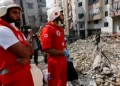

DaysofPal – Gaza faces a deadly and long-lasting legacy from two years of relentless bombardment: tens of thousands of tons of unexploded Israeli ordnance scattered across its shattered landscape. UN agencies and humanitarian groups warn that clearing the territory of these lethal remnants could take two to three decades, posing a grave threat to returning civilians and reconstruction efforts.
A Land Buried Under Explosives
Recent reports by the Gaza Rights Centre (GRC) estimate that around 71,000 tons of explosives and unexploded materials are buried within 65 to 70 million tons of rubble across the Gaza Strip. The figures, echoed by Gaza’s Civil Defense Organization, highlight the unprecedented scale of contamination left behind after years of airstrikes and ground assaults.
The GRC and the Gaza Government Media Office further estimate that at least 20,000 unexploded bombs, missiles, and munitions remain hidden under debris in residential neighborhoods, schools, and infrastructure sites. The UN Mine Action Service (UNMAS) has warned that between 5% and 10% of all weapons fired into Gaza failed to detonate, effectively turning the territory into what one expert called “an open minefield.”
Nick Orr, an explosive ordnance disposal specialist with Humanity and Inclusion, said that removing mines and unexploded ordnance (UXO) from Gaza will take no less than 20 to 30 years. “The level of contamination is extremely high,” Orr explained. “Clearing Gaza requires heavy engineering equipment and safety infrastructure, but none of that can currently be brought in.”
Orr, who has visited Gaza multiple times during the war, described the Strip as one of the most heavily contaminated areas in modern conflict history. His seven-member team is expected to begin initial surveys next week, focusing on essential sites such as hospitals, bakeries, and water facilities where unexploded ordnance poses an immediate risk to civilian life.
One of the Densest Contamination Zones on Earth
According to Gaza’s Government Communications Office, the enclave contains an estimated 58 unexploded items per square kilometer, one of the highest densities ever recorded globally. UN data shows that approximately 40% of residential neighborhoods in northern Gaza, including Beit Lahia, Beit Hanoun, Jabalia, and border areas, are among the most contaminated, with about 3,000 tons of UXO concentrated there. Clearing these areas alone could take relief teams at least ten years.
In central Gaza, the United Nations Office for the Coordination of Humanitarian Affairs (OCHA) reports that Nuseirat, Maghazi, Bureij, and Deir al-Balah refugee camps remain unsafe, contaminated by roughly 1,500 tons of UXO. Since the start of the year, explosions from leftover ordnance in these camps have injured 25 people, including children.
A Growing Toll
The humanitarian cost of Gaza’s contamination continues to rise. According to a UN database, more than 53 people have been killed and hundreds injured by unexploded bombs since the end of major hostilities, though aid groups believe the actual numbers are significantly higher. Many victims are civilians returning to what remains of their homes, unaware of the dangers beneath the rubble.
UN experts estimate that 7,000 tons of unexploded ordnance are still buried across Gaza, distributed unevenly among its governorates. They warn that the greatest threat now lies under collapsed buildings, where bombs may have sunk deep into rubble and sand.
As Gaza begins the monumental task of recovery, the hidden remnants of war threaten to stall reconstruction and claim more lives long after the bombs have stopped falling. Without immediate international intervention and the lifting of restrictions on demining equipment, experts warn that Gaza’s ruins will remain deadly for decades to come.
“Every step in Gaza could be a fatal one,” said Orr. “We’re not just clearing explosives; we’re fighting for the right of people to live safely again.”
Shortlink for this post: https://daysofpalestine.ps/?p=68780