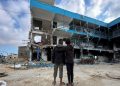
DaysofPal – Two years of genocidal conflict have caused Gaza’s educational system to collapse, depriving nearly a million children of classrooms, books, and hope. UNICEF’s regional director for the Middle East and North Africa, Edouard Beigbeder, has warned that if learning does not resume soon, Gaza may face a “lost generation.”
“This is the third year that there has been no school,” Beigbeder said during an interview in Occupied Jerusalem on Thursday, after returning from the devastated enclave. “If we don’t start a real transition for all children in February, we will enter a fourth year. And then we can talk about a lost generation.”
The war has left vast swathes of Gaza in ruins, displacing the majority of its residents and crippling what little remained of public services. “The destruction is almost omnipresent wherever you go,” Beigbeder said. “It is impossible to imagine 80 percent of a territory completely flattened out or destroyed.”
Makeshift Learning in a Landscape of Rubble
A fragile US-brokered ceasefire that took effect earlier in October has allowed UNICEF and partner organizations to establish temporary “learning centers” for a fraction of Gaza’s children. But these centers reach only one-sixth of those who should be in school, Beigbeder told AFP.
“They have three days of learning in reading, mathematics, and writing, but this is far from a formal education as we know it,” he said. Many of these makeshift classrooms are tents or metal structures covered with plastic sheets, often near displacement camps. Children sit on mats or pieces of carpet, using cardboard boxes or wooden planks as desks, and write on salvaged slates or plastic boards.
“I’ve never seen everyone sitting properly,” Beigbeder added. “But what’s remarkable is their determination to learn, even in these conditions.”
Despite the lull in fighting, the state of Gaza’s education system remains catastrophic. According to UNICEF, 85 percent of schools are destroyed or unusable. Many of the remaining buildings are sheltering displaced families, while both teachers and students are constantly on the move, struggling to survive.
Before the war, Gaza’s classrooms were already overcrowded, with half the population under the age of 18. Of the 300 schools managed by the Palestinian Authority, Beigbeder said 80 required renovation even before the war. Now, 142 have been completely destroyed, and 38 are inaccessible because they lie within areas from which Israeli forces withdrew under the ceasefire terms.
Barriers to Rebuilding and Hope
Rebuilding Gaza’s shattered education system is proving nearly impossible under the ongoing blockade. UNICEF says one of its top priorities is securing permission to bring in materials for semi-permanent schools and school supplies, items Israel has frequently blocked at border crossings as “non-essential.”
“How can you rehabilitate classrooms if you don’t have cement?” Beigbeder asked. “And above all, we need notebooks and books, blackboards, the bare minimum.”
Israel’s repeated restrictions on supplies during the war have worsened Gaza’s humanitarian catastrophe. The UN has warned that parts of the territory are already facing famine, as children suffer both hunger and trauma.
For UNICEF, education is not just about reopening schools; it is about restoring dignity, stability, and hope to a generation robbed of its childhood. “We must put education at the top of the agenda,” Beigbeder said. “Without it, there will be no future for Gaza’s children.”
Shortlink for this post: https://daysofpalestine.ps/?p=68777