When Israel sealed off Gaza’s borders last month, Ibrahim al-Madhoun did what most people did—he rushed to the market and grabbed whatever he could. A few cans of beans, some rice, tuna, and grains. Just enough to get his family by. But that tiny stockpile ran out two weeks ago.
Now, the 46-year-old father of five, who also cares for his elderly mother, is down to serving his family a single meal a day—flatbread sprinkled with thyme.
“Even that won’t last much longer,” he says quietly. “We’re nearly out of wheat flour.”
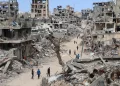
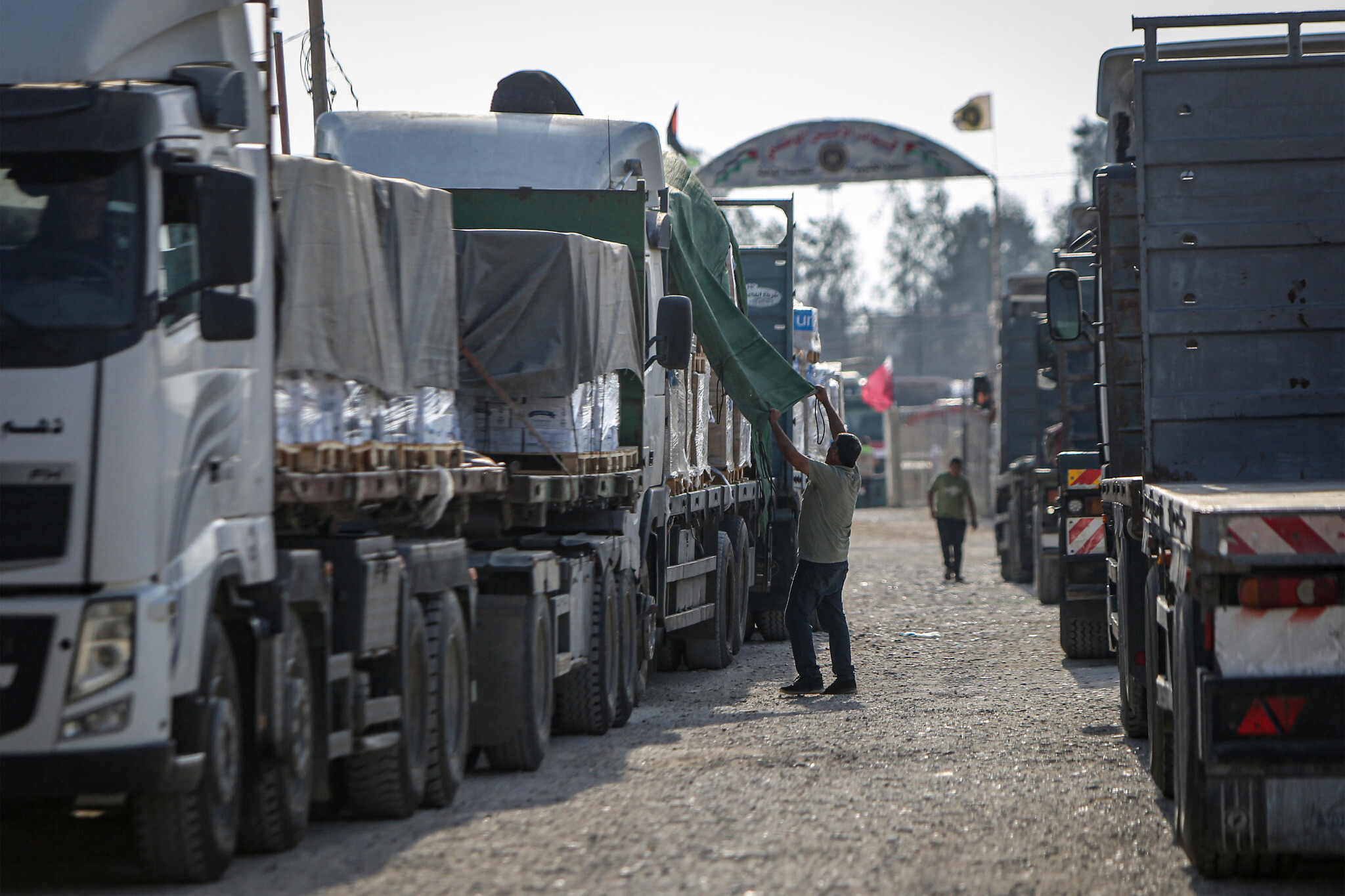
Since early March, nearly all humanitarian aid into Gaza—roughly 95% of UN and NGO support—has come to a halt. Warehouses have run dry. What was once a lifeline for Gaza’s 2.3 million residents has been severed entirely, just as Israeli bombardments and restrictions continue to tighten.
“I never used to rely on aid,” says Madhoun, who worked as a taxi driver before the war. “But since the border closures and the collapse of commercial supply lines, everything changed. You can’t buy what isn’t allowed in.”
Bread, Firewood, and Silent Hunger
On April 1, all 25 bakeries supported by the World Food Programme were forced to shut down due to a lack of flour and fuel. Today, families across Gaza are using their last sacks of flour to bake bread in outdoor firewood ovens.
“We’re surviving on bread and thyme,” Madhoun says. “It’s enough to keep us alive, but we’re not healthy.”
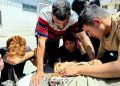
He recently took his two-year-old son to a UN clinic in Gaza City. The boy looked fine on the outside, but doctors told Madhoun his child was severely malnourished.
“He’s not skinny, so I didn’t realize,” he says. “But they told me that malnutrition doesn’t always show. He’s missing essential nutrients—things you can’t get from bread and canned food.”
Madhoun considers himself fortunate compared to others who have nothing at all. But he also knows the end is near. “I have no plan B,” he admits. “I’m just hoping the aid comes back in before we have nothing left.”
The Collapse of Gaza’s Food System
Gaza’s agricultural system, once a modest buffer during border closures, has nearly collapsed. Over 80% of croplands are either bombed, bulldozed, or fall within military buffer zones. The once-rich farmlands of Khan Younis, especially the al-Mawasi area, are now crowded with tents sheltering displaced families.
“Al-Mawasi was one of Gaza’s biggest food producers,” says Israa Abushaban, an environmental engineer working with the Water Authority. “Now, it’s a massive displacement camp.”
With so many people living on the farmland, water contamination has worsened. “Toilets here are makeshift cesspits that leak into the soil,” she explains. “They’re poisoning the groundwater that farms used to rely on.”
The few functioning farms left produce only a fraction of what’s needed. What little vegetables exist are now luxury items. Tomatoes and cucumbers that once sold for under a dollar per kilo are now ten times the price. Most families can’t afford them. Fruits have disappeared altogether.
“Other farmlands—especially in the east, north, and in Rafah—have been annexed into the buffer zones,” Abushaban says. “They’re completely off-limits now. It’s not just a food crisis. It’s the collapse of Gaza’s entire food basket.”
Shortlink for this post: https://daysofpalestine.ps/?p=62646