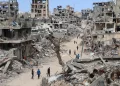
DayofPal– Simple steps down the streets of Khan Younis, Deir Al-Balah, Nuseirat, or Al-Bureij are enough to prove that famine is no longer just looming; it is now fully present, with its burden being laid on poor people sheltering southern Gaza Strip.
There is a clear absence of basic food supplies from the popular stalls lining the streets of these areas in the south—no flour, no sugar, no rice, and not even the canned goods that displaced people previously received as humanitarian aid.
When such items are available in the markets by some traders, their prices are unimaginable and surpass what people can afford.
The Asda area market in Khan Younis, southern Gaza, once was a hub for displaced people seeking essential goods and a place bustling with crowds throughout the day, now it fails to attract them; the stalls are mostly empty, with only a few limited items available at high prices.
Umm Karim stood with bewildered eyes, surveying the stalls around her. “I came here hoping to find what I needed,” she told Al-Risala, “but the severe shortage of food supplies has left me utterly stunned!”
She wonders, “How long will this situation last? Are the Arabs waiting for us to starve to death before they demand that the Israeli occupation open the crossings and allow goods in?”
Not far from her, a passerby asked, “How much does a pound of flour cost?”
“25 shekels,” replied the seller. A third person commented, “Since when is flour sold by the pound?!” The first asker responded, “Since there’s no flour in the strip; may Allah help us.”
The familiar sight of citizens gathering in front of the few struggling bakeries in the southern Gaza Strip has reemerged, a testament to the ongoing crisis they have ensured.amid large-scale closure of borders.
At noon, Umm Mohammed navigated the sea of women, desperately vying for a place near the bakery door. “I have no flour left in my tent,” she exclaimed. “I must get a loaf of bread, or my children will go to bed hungry!”
She went on, “I finished the last bag of flour I had a week ago. I even had to resort to using spoiled flour, infested with weevils and worms, just to feed my children!” Afterward, she recounted her trip to the market in search of a new bag, only to return empty-handed.
A Palestinian father further added: “I’ve waited since dawn with no guarantee of enough bread for my family,” says Abu Jalal. Metal barriers now control crowds, and many bakeries have closed, leaving families; especially displaced ones, struggling to access this daily staple.
This time, famine has taken on a new face. During the initial chaos of war, Gazans still had some savings—what they considered their “lifetime nest egg”—to help meet their needs. Now, over a year into the war, with displacement, dwindling income, and severely restricted means of survival, the reality is far more desperate.
The shadow of famine hangs over the southern Gaza Strip, a haunting reminder of the grueling months endured in the northern Gaza Strip. As memories of hunger and hardship linger, people are left to ponder whether the south will soon face a similar plight of scarcity and despair.
Shortlink for this post: https://daysofpalestine.ps/?p=58338