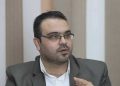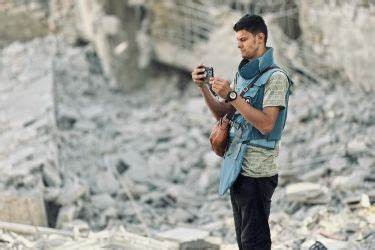
DayofPal– The children of Jabalia camp in northern Gaza know him very well; he has immortalized countless moments while guiding them through a life shaped by the occupier and the horrors of genocide.
Between playing games and photography, he brings joy, serving as a beacon of hope through his humanitarian work, distributing food and toys to the little ones. In every smile he captures, there’s a story told by the lens of journalist Fadi Al-Wahidi.
Al Jazeera correspondent Fadi Al-Wahidi was a friend of joyful moments, capturing children’s laughter and cheers as they gaze at the rockets of resistance streaking across the camp’s sky towards their occupied homeland, immortalizing their spirit through his lens.
Today, Fadi Al-Wahidi’s life was forever altered when he collapsed before the cameras, hit by an Israeli quadcopter’s bullet while covering Israeli atrocities in northern Gaza. He was part of a group of journalists who were attacked while on duty in Jabalia.
From the onset of the genocide, the Israeli military has claimed the lives of 176 journalists in Gaza, aiming to break their spirit and silence their voices.
Yet, the Palestinian journalist, like many others in the community who have borne this heavy toll, continues to stand resolute and fearless, confronting the price anew with every clash.
Out of nowhere, Fadi Al-Wahidi collapsed on the ground of the camp, a haunting echo of journalist Shireen Abu Akleh, sprawled on the pavement before his colleagues in Jabalia Camp.
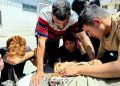
They bravely pulled him into their arms and raced him to the nearest hospital, desperately fighting to save the young man from the bullet that had struck his neck.
Al Jazeera correspondent Mohammed Qareeqah recounted that Fadi, at just twenty-four, is a young man facing immense challenges. His mother is fighting cancer, and as her eldest son, he carries a heavy burden. He began his career working with various television channels in photography and editing, ultimately dedicating himself to covering the war with Al Jazeera.
Qareeqah continues: ‘His mother dreamed of celebrating his marriage, for he is her firstborn. But today, we must face the reality that Fadi’s life has changed irrevocably. According to the latest diagnosis, doctors have confirmed that the bullet that struck his neck has left him with partial paralysis, and we cannot predict when his condition will stabilize.
“He is awake now, yet he cannot feel his legs. We all hold onto hope for his recovery; he is not just the eldest son, but also the family’s main support,” Qareeqah added.
Anas Al-Sharif, a correspondent for Al Jazeera, recalled the harrowing moment when he was with Fadi Al-Wahidi during the attack: “We were in the Safatawi area, a place not far from the targeted zones, preparing to return when, out of the blue, a drone began firing directly at us. We sprinted, trying to escape as the drone relentlessly followed us, targeting the broadcast vehicle.
Suddenly, Fadi collapsed, and we feared he had been killed. Yet, we hold onto hope for his recovery, Anas said in pain.
The Israeli assault on Fadi Al-Wahidi occurred just two days after Al Jazeera photographer Ali Al-Attar was injured and now faces a critical condition, requiring urgent transfer for treatment abroad to save his life.
Al Jazeera condemned the Israeli occupation forces for their attack on its crew in Jabalia Camp in northern Gaza, which resulted in Fadi Al-Wahidi’s injury.
In a troubling sequence of events, prior to this incident, an Israeli warplane struck the crew of Al-Aqsa TV while they were reporting on the situation in Jabalia. This attack led to the killing of their photographer, Mohammad Al-Tanani, and left their reporter, Tamer Labed, injured.
Following Al-Tanani’s assassination, the Government Media Office in Gaza announced that the number of Palestinian journalists killed has now reached 176 since the onset of the genocide, which began on October 7, 2023.
Shortlink for this post: https://daysofpalestine.ps/?p=57896