Source: Electronic Intifada
I vividly remember when our electricity crisis began.
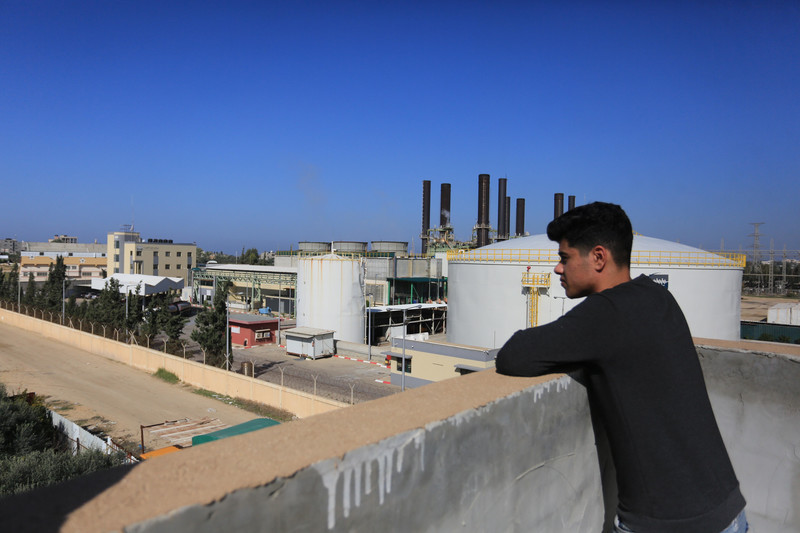
On 28 June 2006, Israel bombed Gaza’s only power station.
For me, then aged 16, the bombing was a source of frustration and disappointment.
I had been watching the World Cup that month, cheering for Argentina, one of my favorite teams at international level. Two days after the bombing Argentina played Germany in a quarterfinal.
I was unable to watch the match on TV.
My sense of disappointment soon grew into something bigger.
Life in Gaza was completely changed by the bombing. For everyone, the question of how to find enough power for our daily needs became a preoccupation.
It was the main topic of conversation. We quickly grew obsessed about how to light our homes.
Candles sold out quickly. So we often had to use flashlights.
We started to rely on the radio for news and entertainment. Rather than watching football matches, I listened to commentary on them.
In 2008, I had to sit the tawjihi, the final high school exams.
It was very difficult to concentrate as I studied in the evenings. I constantly heard the noise of generators; they were very loud.
My grandmother told me to imagine that the noise was from a party. She was essentially saying that the situation had been imposed on us and we couldn’t do anything about it.
Occasionally I went to a park near Beach refugee camp in Gaza City. It had a light so I would try and study there.
Many other students tried to prepare for exams under the few streetlights. Some even depended on the lights from passing cars.
Surviving against the odds
Everything got worse during Operation Cast Lead – a major Israeli assault on Gaza in late 2008 and early 2009.
For 10 days, my family had no electricity at all.
Our supply of water was cut off, too. We need electricity so that water can be brought to our homes.
We tried our best to find water and fuel, particularly gas.
Operation Cast Lead lasted for more than three weeks. We got some power back afterward but the electricity crisis that began in 2006 has never been properly resolved.
Somehow we survive.
Now, we depend a great deal on rechargeable batteries, especially for lighting and for the internet. There is scarcely a home in Gaza without batteries.
There are some large generators in various parts of Gaza and we pay subscription fees for them. The fees are a major strain on the finances of many families.
While small generators proved vital in the early stages of the crisis, we use them less today.
In 2019, I traveled to Egypt and Jordan for the first time.
It came as something of a shock to see that the supply of electricity was uninterrupted in both countries. I didn’t experience any of the power cuts that had become so routine in Gaza.
To my amazement, it took much less time than “normal” – bearing in mind that nobody should view the Gaza situation as normal – to recharge my cellphone and laptop.
There have been some changes in Gaza. Over the past few years, most people have stopped using candles to light their homes.
The avoidance of candles followed a number of horrific incidents. Children have been burned to death in cases where rooms lit by candles went on fire.
Forced out of business
Power shortages have caused major problems for the economy, too.
Samer Abu al-Samoud, 48, is a carpenter and one of many people from Gaza who used to commute between here and Israel for work. That stopped in 2000, when the Israeli military withdrew a work permit for him, citing “security” reasons.
Abu al-Samoud then opened a small carpentry workshop in Gaza.
Since the electricity crisis began in 2006, he has found it extremely difficult to process orders for furniture. On many occasions, he did not have enough money to settle bills for timber and other materials.
Unable to pay debts between 2019 and last year, Abu al-Samoud was jailed several times.
“Many people in Gaza have gone out of business because the electricity keeps cutting out,” he said. “Fuel is expensive and generators are often out of order.”
In Gaza, we sometimes call those born since the power crisis began the “electricity generation.”
The crisis cannot be separated from the complete blockade Israel imposed on Gaza in 2007. Because that siege has robbed so many opportunities from so many people, we sometimes call those born during it the “lost generation.”
My 16-year-old cousin Shadi Muhanna is part of the electricity – or lost – generation.
“I used to think that everyone in the world was suffering from wars and electricity and water shortages,” he said. “I even thought the Israelis had the same problems. I was shocked to learn the opposite.”
As well as Jordan and Egypt, I have traveled to Turkey and Sudan.
There are many social problems, including serious poverty, in all of these countries. But they have electricity.
Gaza’s power crisis has persisted because Israel is subjecting us to the kind of blockade you can read about in history books about the Middle Ages – though with help from advanced weapons, many supplied by the US.
When will we finally be treated as human beings?
Amjad Ayman Yaghi is a journalist based in Gaza.
Shortlink for this post: https://daysofpalestine.ps/?p=34000