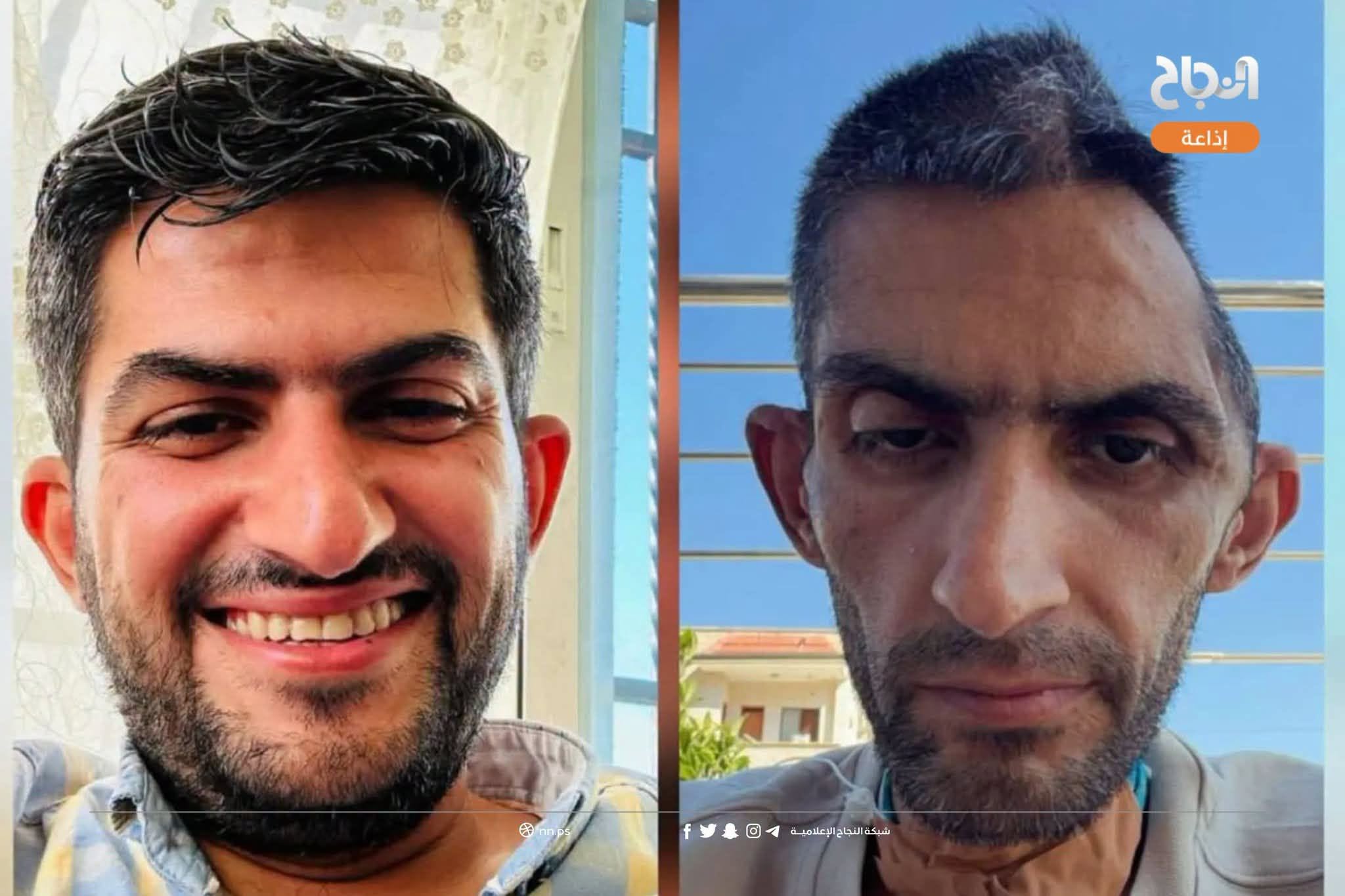
DaysofPal- Palestinian journalist Mujahid Bani Mufleh’s detention was a long journey through darkness after 14 months in Israeli prisons. He came out with a brain hemorrhage, a body marked by repeated beatings, and a spirit grievously wounded. Barely stepping into freedom, he found himself racing against death on an operating table, in a scene that mirrors the harsh reality faced by prisoners behind the walls of Israeli prisons.
On the early morning of June 28, 2025, a large Israeli military force stormed the home of journalist Mujahid Muhammad Bani Mufleh (37) in the town of Beita, south of Nablus, without warning or knocking.
His wife, Nuha al-Sharfa, described the moment, saying that soldiers suddenly appeared inside their home. She said they assaulted her husband, destroyed his personal office, confiscated his computer, and then took him away in handcuffs to the Huwara military detention center.
This was not his first arrest; Israeli forces had previously detained him twice, in 2015 and 2020, releasing him both times without formal charges.
Ten days after his latest arrest, Israeli military courts placed him under administrative detention for four months without charge or trial, a system that allows imprisonment based on a “secret file” inaccessible to both detainee and lawyer.
When the initial period ended, his detention was extended for another two months, followed by an additional extension after his lawyer’s appeal was rejected. In this way, months accumulated over his shoulders inside Menashe prison at the Salem military camp north of the occupied West Bank, while his three children waited for their father behind closed doors.
“Heavy days in which I lived hunger until bread became a dream, thirst until water became a blessing, and various forms of humiliation and torture that could reshape the soul before the body,” Bani Mufleh wrote after his release. “Between cold walls and long nights, I learned how hunger can break pride and how pain strips a person of everything except faith and patience.”
His suffering was not an isolated case. According to documentation by the website Ultra Palestine, where he works as an editor, systematic deprivation inside Israeli prisons caused him to lose around 25 kilograms during his detention. He was also subjected to severe physical assaults, particularly targeting his head and back during repeated beatings, especially while being transferred between cells, often with his hands and feet tightly shackled for long hours, leaving him numb.
From Prison Gate to Operating Room
On January 12, 2026, the prison gates finally opened. However, freedom was short-lived before pain extended beyond the prison walls. Just two days after his release, his health suddenly collapsed. He suffered severe fatigue, difficulty walking, and loss of sensation in his limbs. He was rushed by ambulance to the Istishari Hospital in Ramallah during the early hours of the night.
Medical examinations revealed a serious brain hemorrhage and dangerously high blood pressure, requiring immediate surgery in the early morning hours.
The Prisoners’ Media Office described what happened as a “delayed execution” or “slow killing,” stating that Israel releases detainees only after exhausting their bodies, leaving them to face a new phase of suffering outside prison. The office held Israeli authorities fully responsible for any deterioration in Mujahid’s health. He continues to suffer from a limp caused by prolonged use of shackles, while his hands still endure nerve damage and loss of sensation.
193 Journalists Detained: A Wider Pattern
Mujahid Bani Mufleh’s case is not an exception but part of a broader pattern of repression against journalists. Since the start of Israel’s war on Gaza in October 2023, the Palestinian Prisoners’ Club has documented the arrest or detention of at least 193 Palestinian journalists, with many still behind bars.
Most journalists are charged with “incitement” based on their media or social media activity, while others are held under administrative detention orders based on secret files that cannot be challenged.
In Gaza, Israeli authorities classify journalists as “unlawful combatants,” a designation used to justify systematic killings that have already claimed the lives of dozens of media workers.
During his prolonged medical struggle, Mujahid reflected on his experience, writing: “I realized that the blessings we once considered ordinary were more precious than we imagined: a full meal, safe sleep, a pain-free breath, a step without disability, and the face of a loved one seen without barriers. Fourteen months were enough to teach me that health is a crown, freedom is life, and dignity is not a minor detail but the very soul of a human being.”
These words, written by a hand still struggling to remember how to hold a pen, capture what statistics and reports often fail to convey: that the price of free expression in Palestine can be heavier than a human being can bear.
Shortlink for this post: https://daysofpalestine.ps/?p=75717