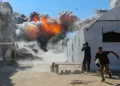
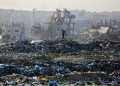
DaysofPal – After two years of relentless Israeli bombardment, Palestinians in Gaza are facing a new and invisible crisis: contaminated water. The destruction of critical infrastructure has left the vast majority of residents without access to clean or safe drinking water.
People in Gaza are aware that the water they drink, the air they breathe, and the food they eat may be unsafe. But when every day is a struggle to survive, to find a bit of water, a loaf of bread, or shelter, safety has become a luxury.
“We have no choice,” one resident said. “We drink whatever water we can find.”
The war has devastated Gaza’s sanitation systems, wells, and sewage networks, leaving environmental contamination unchecked. Unexploded ordnance, toxic debris, and untreated sewage now mingle with what remains of the territory’s water sources. Efforts to clean or repair the damage are nearly impossible: municipal authorities simply lack the equipment, fuel, and heavy machinery to operate.
Local crews work day and night to clear rubble from streets and reopen blocked roads. But without proper machinery or power, restoring basic services like clean water remains out of reach.
Gaza’s Water Crisis Deepens
In Gaza City, residents face an acute water shortage that makes it nearly impossible to stay in or rebuild their devastated neighborhoods. The massive destruction of the sewage and water systems has rendered 80% of the city without access to potable water.
Engineer Maher Salem, Director General of Planning at Gaza Municipality, said the occupation “focused deliberately on destroying services and infrastructure, including water networks and wells,” particularly in the city’s northwest.
He explained that the Sheikh Radwan pond, a key sewage reservoir, was a primary target. “The occupation destroyed its pumps and the pipeline connecting the pond to the sea,” he said.
“We are approaching the rainy season, and the sewage level in the pond has reached five meters, only one meter away from overflowing into the streets.”
The destruction has made it impossible to manage drainage or sewage properly. Salem warned that flooding could soon spread waste and disease through already devastated neighborhoods.
72 of Gaza City’s 88 Wells Destroyed
According to the municipality, Israel destroyed 17 water wells in the neighborhoods of Sheikh Radwan, Tel al-Hawa, and Shuja’iyya in just two weeks, nine of them in Sheikh Radwan alone, cutting off water entirely to large areas of the city.
Municipal teams are racing against time to repair or replace wells, relying on private submersible pumps and water delivery trucks to distribute what little water remains.
The destruction, however, is near total. “The total number of wells destroyed by the occupation in Gaza City during the war has reached 72 out of 88,” Salem said, “making it almost impossible to restore a stable water supply.”
Before the latest wave of attacks, 115 kilometers of Gaza City’s water network had been damaged. Now, over 150 kilometers of water lines lie in ruins. The city’s sewage system, once spanning 195,000 linear meters, has also been wrecked; the damage now extends beyond 200,000 meters.
The main sewage treatment plant in the Zeitoun neighborhood has been almost completely destroyed, causing raw sewage to accumulate in residential areas and flow through streets.
Municipal engineers warn that without immediate international intervention, Gaza could face a full-scale public health disaster. Contaminated water, open sewage, and limited medical care create ideal conditions for the spread of disease.
Shortlink for this post: https://daysofpalestine.ps/?p=69192