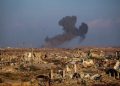
DaysofPal – A new United Nations Security Council resolution has triggered an outpouring of criticism over what many see as the revival of a colonial-era model in Palestine. The resolution, passed on Monday, authorizes an international force in Gaza with permission to use “all necessary measures” to enforce its mission, a phrase that analysts say grants sweeping military and administrative powers over the devastated territory.
Under the plan, US President Donald Trump will oversee a two-year transitional period through a so-called “International Stabilization Force” (ISF) and a “board of peace” responsible for shaping Gaza’s political future. Multinational troops, select Palestinian technocrats, and a local police force are expected to implement the program.
A New ‘Mandate’ and Old Colonial Shadows
For many observers, the framework evokes a past that Palestinians know too well. British-Israeli historian Avi Shlaim described the initiative as “a classic colonial scheme,” telling Middle East Eye that it mirrors the British Mandate imposed a century ago. Helena Cobban, author of Understanding Hamas, noted that even the word “mandate” carries heavy historical baggage in West Asia, where it once justified foreign control by claiming local populations were “not ready” for self-governance.
Resolution 2803 makes a vague reference to Palestinian statehood, but only if unspecified conditions are met. Daniel Levy, a former Israeli negotiator, argued that by attaching conditions to a fundamental right, the UN has transformed itself “into a body that undermines” international law.
The vote passed with 13 members in favor and abstentions from Russia and China, neither of which used their veto. A broad group of Muslim-majority and Arab states backed the plan, encouraged by the Palestinian Authority’s endorsement, giving political cover for reluctant states to fall in line.
Uncertain Implementation and Global Backlash
Hamas and other Palestinian factions have rejected the resolution outright, especially its implicit call for disarmament. The demand raises immediate practical concerns. Israel, despite two years of intensive warfare, has not eliminated Hamas. Critics question how an international force could succeed and which Arab or Muslim states would volunteer to do so.
Cobban noted that no regional military would be eager to undertake a task Israel could not accomplish. While Hamas has previously suggested its armed wing could be integrated into the security forces of a future independent Palestinian state, that scenario remains distant.
With unclear deployment plans, resistance on the ground, and significant political opposition, the resolution’s implementation appears uncertain. Yet its symbolic weight, a UN-approved, US-administered plan for Gaza, may be more consequential than its practicality.
Cobban warned that the Security Council’s decision represents a severe blow to the credibility of the UN. “What happened at the Security Council has brought infamy to the United Nations,” she said. “It may take years for the institution to recover, if it ever can.”
Shortlink for this post: https://daysofpalestine.ps/?p=69515