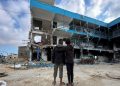
DaysofPal – Near the shell of a burned-out car targeted in front of his home, Faiq Ajour and his relatives sifted through debris and shattered glass, trying to make sense of yet another assault on their already devastated lives.
Moments before the strike, Faiq had stepped out to buy vegetables from a nearby stall.
“I survived by a miracle. I had just crossed the street,” he said, still shaken by the narrow escape and haunted by the fear that his house had been hit.
His family was physically unharmed, but his three young daughters trembled in terror. The attack, they feared, was proof that Israel’s war on Gaza, supposedly suspended after a ceasefire in October, had returned in full force.
A mere ceasefire in name
Although a ceasefire was officially in place, Israeli attacks have continued across the Gaza Strip, with Israel claiming violations by Palestinian factions. Palestinians, however, emphasize that Israel has been the primary violator, breaching the agreement hundreds of times and killing more than 300 civilians, including dozens of children, since the truce began.
The strike in Gaza City’s al-Abbas neighborhood, where Faiq lives, killed five people. Across the Strip, 24 Palestinians were killed that same day.
“This is a nightmare, not a ceasefire,” Faiq said. “One moment there is calm, and the next, everything turns into a war zone again. You see body parts, smoke, ambulances, and people running. We still haven’t healed from these scenes.”
Faiq, 29, originally from Gaza City’s Tuffah neighborhood, has endured unimaginable loss.
In February 2024, he lost 30 members of his extended family in a single Israeli strike, including his parents, his nephews, his aunt, and his cousins. His wife was severely injured, losing one of her fingers.
“My mother, my father, my brother’s son… my whole family was gone,” he said quietly.
Since then, he has moved multiple times across Gaza, chasing what he calls “a safety that doesn’t exist.” The ceasefire, he says, has offered nothing resembling security.
“Every few days, there’s a new wave of strikes. Everything turns upside down without warning.”
Unable to return to his home inside the heavily restricted “yellow line,” an area under total Israeli control, he has lost his work, his property, and the life he once knew.
“There’s no construction, no infrastructure, no work, no life,” he said. “Today I sit at home 24 hours a day. We are surviving on bitterness. We’re not frustrated; we are living a catastrophe. Let us live. Let us reopen our shops and our crossings. Let us breathe.”
Uncertain Future, Endless Debate
While residents fight to survive, powerful governments are debating Gaza’s future. One international proposal envisions a transitional technocratic government, supervised by a global “board of peace” and supported by an international stabilization force. The plan also promises economic development, but the details remain vague, and the destruction across Gaza means reconstruction will take years.
Israel, on the other hand, declines to pledge to put an end to the conflict. Analysts say Israeli leadership prefers to maintain the current limbo, avoiding political obligations such as reconstruction.
“Israel is working to entrench a state of ongoing instability,” explains Palestinian analyst Ahed Farwana. He believes Israel is executing a strategy similar to its approach in southern Lebanon, where targeted killings and occasional strikes continue despite a ceasefire.
According to Farwana, Israel seeks to expand its control over parts of Gaza, seizing land to strengthen its position in any future arrangements and obstructing a transition into the so-called second phase of the ceasefire.
Inside Israel, political dynamics further complicate the situation. Prime Minister Benjamin Netanyahu faces immense pressure from far-right allies and is wary of any step that could threaten his hold on power. With multiple corruption trials looming and elections approaching, he is widely seen as prioritizing political survival over progress in the ceasefire.
International pressure exists, particularly from Washington, but not enough to force Israel into a full halt of hostilities.
As a result, Gaza remains trapped in a fragile in-between state: occasional calm punctuated by targeted assassinations, yellow-zone expansions, and renewed strikes.
‘Our Life Is a War Without an Actual War’
For Gaza’s residents, this limbo is indistinguishable from war. Raghda Obeid, a 32-year-old mother of four, has been displaced repeatedly. Her home in Shujayea is completely destroyed, and she now lives with her family in a tent in western Gaza City.
Last week, an Israeli strike hit nearby. “The moment of the last strike was terrifying, exactly like the first day of the war,” she said. “People were running and screaming, carrying the killed and the torn apart.”
Terrified for her children, Raghda thought, “That’s it, the war is back, and it’s our turn.”
Her daily life is consumed by survival. She and her husband search for food and water. Their children roam between community kitchens hoping for a meal. Winter is approaching, and they expect to remain in the tent indefinitely.
“I don’t know what is expected from us. It’s been more than two years, and now we’re entering a third, displaced and broken like this. Isn’t there a solution for us?”
With no income and no home, Raghda says their life has become “a war without an actual war.”
Shortlink for this post: https://daysofpalestine.ps/?p=69770