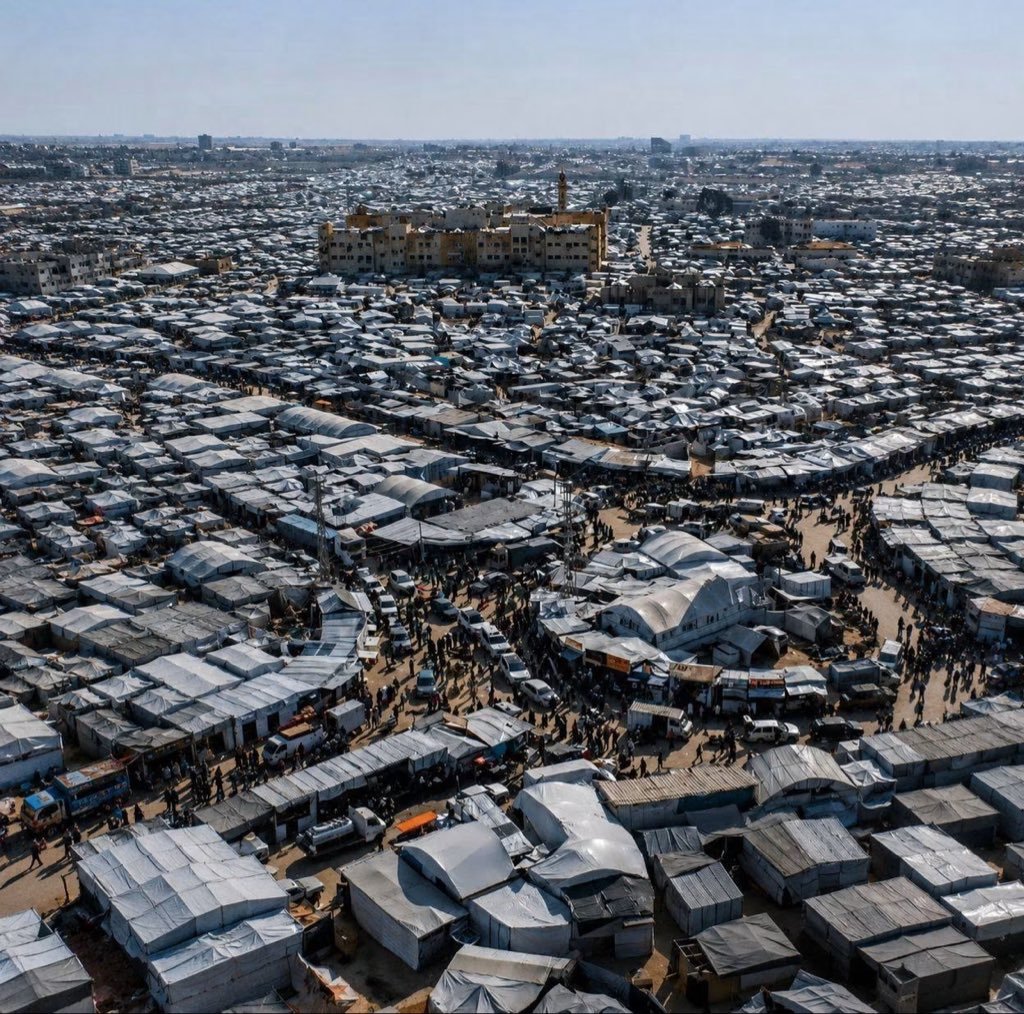
DaysofPal – In recent days, discussions have re-emerged regarding plans to establish so-called “humanitarian shelter centers” in Rafah, a region currently under the direct control of the Israeli occupation forces.
While these initiatives are publicly framed as benevolent measures aligned with broader international blueprints to halt the ongoing war, the underlying operational mechanisms on the ground remain deliberately opaque. Nominally placed under the administrative responsibility of the “Peace Council,” the actual identity of the actors executing operations on the ground remains unverified, raising profound questions about the true purpose of these installations.
Security-Based Admission Raises Questions
Israeli newspaper Israel Hayom reported Tuesday, citing unnamed sources, that the Peace Council is expected to launch a pilot project within weeks to operate humanitarian shelter centers in areas of Gaza that, according to the report, are not under Hamas control.
The first site is reportedly planned for the Tel al-Sultan area near Rafah, where civilians would be allowed entry only if they are deemed “unarmed” and have no affiliation with Hamas.
Critics argue that such broad and undefined criteria effectively place Israel in charge of determining who qualifies for protection and humanitarian assistance, raising concerns that civilians could be screened according to security assessments rather than humanitarian need.
The report also states that internal security at the shelters would be maintained by personnel carrying non-lethal weapons, while the Israeli military would continue controlling the so-called “Yellow Line,” a buffer zone unilaterally established by Israel inside Gaza. The area under Israeli control has expanded westward and now encompasses more than 70 percent of the territory, according to the report.
Parallel Zones of Control
The reported arrangement would create two distinct realities inside Gaza: demilitarized shelter zones operating under nominal international supervision, and a much larger territory remaining under direct Israeli military control, with no publicly announced timetable for withdrawal.
Israeli reports provide no explanation of who would classify civilians eligible to enter the shelters, how authorities would distinguish between armed and unarmed individuals, or what safeguards would prevent political or security considerations from determining access to food, medical care, and humanitarian aid.
The Israel Hayom report states that assistance would be directed exclusively to these centers as part of an effort to “gradually undermine Hamas’ grip” on Gaza’s population—a formulation critics say indicates that the initiative carries political and security objectives in addition to its stated humanitarian purpose.
Revival of the “Green City” Proposal
The latest proposal closely resembles what the Euro-Mediterranean Human Rights Monitor warned about in January, when it revealed an Israeli-American plan to establish a “Green City” in Rafah to accommodate displaced Palestinians who have spent nearly 1,000 days living in makeshift tents.
The rights organization argued that the project carries serious risks, including arrangements that could effectively force Palestinians from their original communities while transforming large sections of Gaza into closed military zones under direct Israeli control.
At the time, Euro-Med Monitor reported that Israeli forces, working alongside contractors, had begun clearing rubble, leveling land, and preparing the designated area entirely under Israeli control for construction, predicting that preparations would accelerate in the coming months.
The organization described the proposal as another failed response to the consequences of Israel’s ongoing genocide in Gaza, arguing that it seeks to reshape Gaza’s demographic landscape rather than provide genuine solutions for civilians.
Warnings of Forced Segregation
Euro-Med Monitor warned that the proposed “Green City” would effectively isolate Palestinians inside military-controlled enclaves, entrenching their displacement while imposing living conditions that threaten their ability to survive.
According to the organization, relocating Palestinians to an area controlled by Israel and armed groups it has established would amount to a dangerous attempt to redesign both the territory and its population under direct Israeli military administration. It warned that such an arrangement would effectively create a population ghetto, particularly if accompanied by the destruction of Rafah and the denial of residents’ right to return to their homes.
The organization further argued that the plan could amount to multiple violations of international humanitarian law, including the unlawful forcible transfer of civilians, severe restrictions on freedom of movement, discriminatory denial of essential rights, extensive destruction of civilian property without military necessity, and the removal of rubble before bodies are recovered, potentially undermining efforts to identify victims and preserve evidence for future investigations.
Euro-Med Monitor also contends that Israeli-controlled shelter centers would reinforce an ongoing genocidal policy by turning mass destruction and displacement into a permanent reality. Under such a system, displaced civilians would remain confined within security-managed zones regulated through checkpoints, permits, and surveillance while depending on aid controlled either by Israeli authorities or affiliated armed groups.
The Peace Council and International Mandate
The Peace Council derives its authority from United Nations Security Council Resolution 2803, adopted in November 2025, which authorized the deployment of a multinational stabilization force to assist in governing and reconstructing Gaza during a transitional period following the announcement of the council’s establishment by U.S. President Donald Trump in January 2026.
Under the UN framework, Israeli forces were expected to withdraw from most of Gaza following the deployment of the international force, while a Palestinian National Committee supervised by the Gaza Executive Council, headed by High Representative Nikolay Mladenov, would oversee the territory’s civilian administration.
Developments on the ground, however, appear to diverge from that framework.
The first international military vehicles have reportedly arrived at the Endurance logistical support base south of occupied Palestine in preparation for a phased deployment into Gaza. Rather than replacing Israeli forces, the international contingent is expected to deploy initially around Rafah within the Israeli-controlled “Yellow Line,” operating in coordination with the Israeli military.
As a result, the first phase of the international mission would function alongside Israeli control instead of assuming authority over the territory.
The available reports also leave unresolved the role of armed militias that Israeli forces have established or supported in areas under their control. Human rights organizations and UN bodies have documented that such groups have contributed to an insecure environment that has obstructed humanitarian and rescue operations.
Although current plans refer to the creation of a new Palestinian police force and the disarmament or restriction of Palestinian resistance factions, no publicly available documents explain how these Israeli-backed militias, accused of killings, security operations on Israel’s behalf, looting, and contributing to lawlessness, would themselves be dismantled or held accountable.
The Political Weaponization of shelter
Taken together, the leaked Israeli proposal, the UN-backed Peace Council framework, and the earlier “Green City” project all point to the same unresolved issue: who decides which Palestinians are entitled to protection and humanitarian assistance, and according to what criteria?
With Israel unilaterally defining security boundaries through the “Yellow Line,” humanitarian shelters reportedly operating under undisclosed security screening procedures, and armed proxy groups remaining active, critics warn that Gaza risks being divided into separate zones with unequal access to rights, services, and aid.
They argue that, rather than serving solely as humanitarian facilities, the proposed shelter centers could become a new political and security mechanism for reshaping Gaza’s demographic and geographic landscape.
Shortlink for this post: https://daysofpalestine.ps/?p=75875