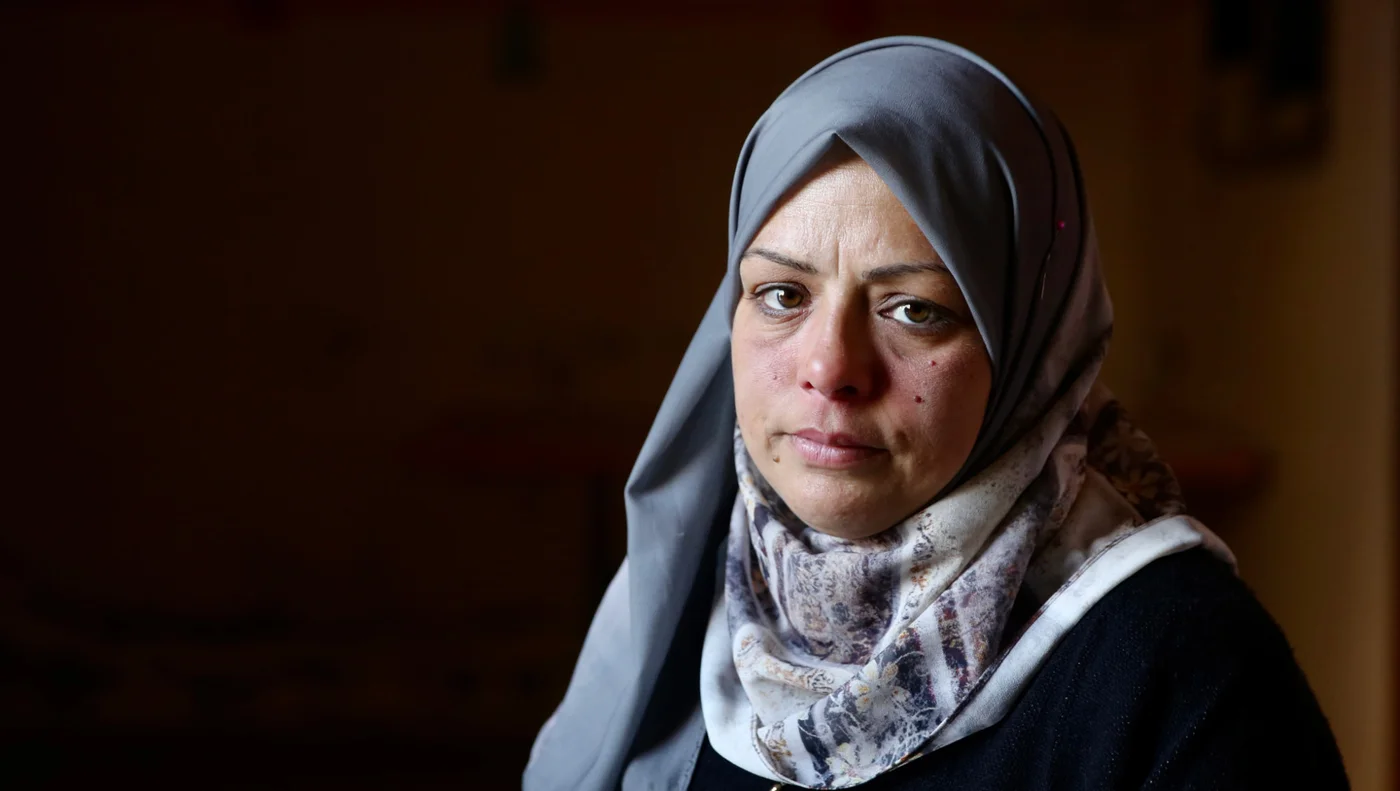
Tahrir Husni al-Arian, nine months pregnant, watched in horror as an Israeli military dog tore into her thigh, her flesh falling to the ground.
The 34-year-old mother of three was at home in Khan Younis, located in the southern Gaza Strip, on October 24, 2024, when Israeli forces invaded her neighborhood of al-Manara. The attack left her with a severe wound and led to the tragic loss of her newborn son.
The dog attack lasted approximately 10 minutes, causing unbearable pain and complications that have left her physically and emotionally scarred. Today, Arian struggles to return to her home, haunted by the trauma of that night.
In an interview with Middle East Eye, Arian recounted the events leading up to the attack. Her family had recently returned to their home after multiple displacements since the war began last year.
Believing the area was safe, they were blindsided when Israeli forces launched an assault at around 8 p.m.
“They started shelling the area with missiles, and flares lit up the sky,” she said.
Moonlit Invasion
As the situation escalated, Arian’s home became a target. Israeli soldiers unleashed a dog that attacked her, leaving her with a gaping wound. She described the soldiers’ response as indifferent; one poured water over her injury and applied a pressure bandage, which she believed was a superficial attempt to conceal what had happened. Before leaving around 2:30 a.m., the soldiers warned her not to speak about the incident.
When the military withdrew, ambulances arrived to tend to the wounded and collect the dead. But Arian was too terrified to leave her home.
“I was paralyzed with fear, scared they’d bomb us while we were outside,” she recalled. She finally left with the last ambulance just before dawn.
At the severely damaged Nasser Hospital, doctors cleaned her wound, which was 15 centimeters wide, administered an anti-toxin injection, and informed her she would likely need a cesarean section due to the injury.
Just a month earlier, Arian had learned during a prenatal check-up that her baby had deformities in his lower limbs. Doctors attributed these complications to the extreme stress, malnutrition, and repeated displacements she endured during the war. Despite this, they estimated a 70 percent chance of survival if the baby was placed in an incubator after birth and received physical therapy.
Tragic Birth
A week after the attack, Arian gave birth to a baby boy named Ibrahim via cesarean section. His condition, however, was critical.
“The doctors told me the surgery had been extremely difficult and that my son’s chances of survival were slim due to the infection from my wound,” she said.
The infection in her thigh worsened, emitting a strong odor. After the delivery, doctors performed another surgery to clean the wound.
“The pain was unimaginable. The smell, the electric devices they used – it felt like I was suffocating,” Arian said, recalling how she asked a nurse to open a window during the procedure.
By morning, the devastating news came: her baby had died in the incubator.
“There was a chance he could have survived, but the dog attack destroyed it,” she said. “I lost my baby, and that was it. But my fear hasn’t ended. I feel like the military marked me, and they’ll come after me again.”
Lasting Trauma
Two months later, Arian continues to grapple with physical and emotional pain. Her wound, which doctors estimate will take eight months to heal, still leaves her struggling to walk.
“I feel severe pain and can barely move,” she said. “Even if the surface looks like it’s healing, the deep tissues will take much longer to recover.”
Psychologically, the trauma runs deep. Arian still sleeps with the lights on and asks family members to accompany her to the bathroom.
Her loved ones try to comfort her, but she remains mistrustful. “You were with me when the dog attacked, and you couldn’t stop it,” she tells them.
“I’ve lost trust in everyone,” she said.
For months, Arian refused to discuss the attack. “Whenever anyone asked, I’d say, ‘Don’t bring it up, please.’ I was terrified.”
Shortlink for this post: https://daysofpalestine.ps/?p=59870