DaysofPal- Israeli military directives ordering the uprooting of trees and the leveling of Palestinian land have increased markedly across the occupied West Bank in recent months, a trend that officials and activists say reflects an organized strategy to confiscate land and accelerate settlement expansion, particularly in the central region of the territory.
Framed under claims of “security and military necessity,” these orders are often enforced swiftly and alongside ongoing demolition and land-clearing operations justified by alleged permit violations, especially in Area C.
The escalation has deepened environmental destruction and economic hardship for Palestinian communities, while facilitating the consolidation of settlement control.
Amir Dawoud, a documentation officer with the Wall and Settlement Resistance Commission, said Israeli occupation has issued 46 military orders since the start of the year related to tree removal across the West Bank.
While some orders do not immediately declare land confiscation, he noted, they frequently lay the groundwork for subsequent seizure.
“These measures often target land overlooking settler roads or areas near settlements under the pretext of security concerns,” Dawoud said.
He added that at least 1,000 dunums have been affected in a short time span, warning that tree removal is commonly followed by orders placing land under Israeli occupation, effectively stripping Palestinians of ownership.
Dawoud emphasized that targeting trees undermines Palestinians’ historical and legal claims to their land.
Under earlier legal standards, active cultivation was a key requirement for maintaining land rights.
By uprooting trees and leaving land uncultivated, he explained, Israeli occupation later reclassifies it as “state land.”
He also warned that Palestinians’ access to legal recourse has worsened significantly since the war, as Israeli courts increasingly reject appeals against military orders, particularly those citing security justifications, often allowing implementation without giving residents adequate time to challenge them.
Salah al-Khawaja, director of the central district at the Wall and Settlement Resistance Commission, said the central West Bank has seen an unprecedented wave of land-clearing and tree uprooting orders as part of a coordinated effort to surround Palestinian towns and villages and connect settlements and outposts.
“These orders leave nothing untouched above ground, especially olive trees,” al-Khawaja said, pointing to the town of al-Mughayyir, where more than 10,600 olive trees were uprooted in under 48 hours.
He noted that al-Mughayyir, which controlled over 41,000 dunums after 1967, now retains only 980 dunums due to decades of confiscation and settlement expansion, reducing it from a productive agricultural center to a marginalized village.
Comparable operations are ongoing in Turmus Ayya and villages west of Ramallah, where land clearing is carried out almost daily under military directives, al-Khawaja added. He said the aim is to dismantle Palestinian livelihoods by seizing farmland and grazing areas.
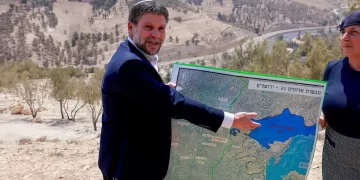
Al-Khawaja described the policy as a coordinated effort under the current Israeli government, highlighting the role of far-right minister Bezalel Smotrich in overseeing the Civil Administration, backed by strong political and legal support to advance settlement growth.
Last week, Israeli forces enforced a military order to uproot 500 olive trees in the village of Budrus, west of Ramallah.
Abdul Nasser Marrar, head of the Budrus village council, said residents were given only 72 hours to object to an order covering 32 dunums near the separation barrier, an unrealistically short period that effectively blocked legal challenges.
He said bulldozing ultimately spread to around 50 dunums, the village’s main agricultural zone, destroying trees, some over 400 years old.
In the southern Nablus district, the village of Qaryut has also witnessed extensive demolitions and land leveling in recent weeks.
Although the Israeli occupation cited a plan to seize 70 dunums for security reasons, residents report that more than 700 dunums were flattened and over 1,000 olive trees uprooted.
Bashar al-Qaryuti, an anti-settlement activist, described the actions as a systematic assault on the land and its owners, aimed at connecting settlement blocs and fragmenting Palestinian villages into isolated pockets.
He warned that authorities are fast-tracking these plans, especially in the central West Bank, to form a large settlement bloc separating the northern and southern regions, exploiting what he called a lack of international pressure and continued legal inaction.
Shortlink for this post: https://daysofpalestine.ps/?p=70632