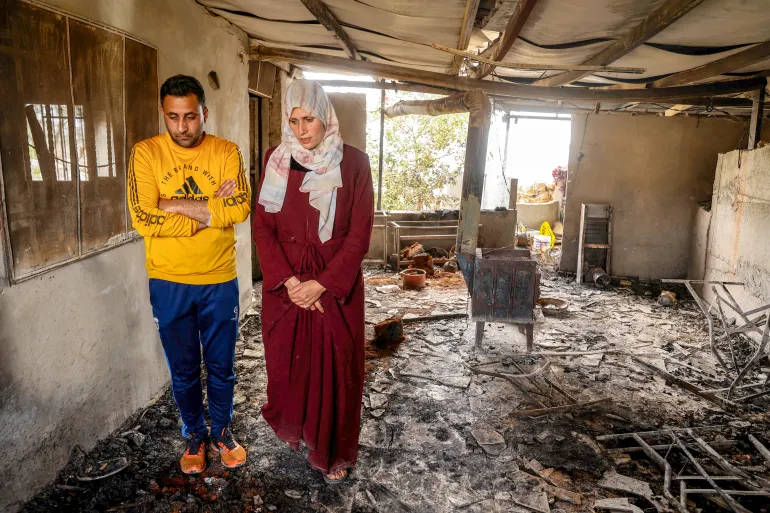
When Israel began bombing Gaza on October 7, 2023, Fayez Atil had a sinking feeling. He knew that his quiet village in the occupied West Bank could be next.
Atil lives in Zanuta, a traditional Palestinian herding community nestled in the Jordan Valley. For years, they’ve faced harassment from settlers in nearby illegal Israeli settlements—but after the war on Gaza began, the violence escalated to a terrifying new level.
“It felt like we were suddenly at war too,” Atil said in a phone interview with Al Jazeera. “Every day and night, settlers tried to steal our sheep, destroy our property, and vandalize our cars.”
Eventually, life in Zanuta became unbearable. One by one, its 250 residents fled the village. Atil left with his family after settlers beat a 77-year-old shepherd in October 2024.
“They attacked the old man, his wife, and even their children,” he recalled. “We had never seen them go that far before.”
Violence Backed by the State
Zanuta is just one of 46 Palestinian Bedouin communities that have been forced from their land in the occupied West Bank since October 7, 2023, according to the Palestinian rights group Al-Haq.
Human rights advocates say this isn’t just about radical settlers — it’s part of a broader, state-backed campaign.
“This is state violence, plain and simple,” said Shai Parnes, spokesperson for the Israeli human rights group B’Tselem.
When the war in Gaza started, Israel redeployed thousands of soldiers from the West Bank and replaced them with settlers — many of whom were armed, wore military uniforms, and were effectively given authority over Palestinian communities, Parnes explained.
In Area C — the largest portion of the West Bank, rich in farmland and making up about 60% of the territory — settlers have taken advantage of the power vacuum. This area was established under the 1993 Oslo Accords, which were meant to pave the way for a future Palestinian state. But since then, illegal Israeli settlements in the region have expanded rapidly, their population growing from 200,000 to more than 750,000.
A System of Displacement
Even Palestinian Bedouins who are Israeli citizens say they’re being forced off their land.
Around 120,000 Palestinians live in what are known as “unrecognized villages” across the Naqab (Negev) Desert. These communities are made up of descendants of Palestinians who survived the 1948 Nakba — the mass displacement of Palestinians during the creation of Israel.
The Israeli government insists these Bedouins should move to designated cities, but doing so would sever their ties to the land and their way of life as herders.
“Bedouins have been living on this land for generations. We’re Indigenous — we can’t just be relocated like furniture,” said Khalil Alamour, a Bedouin community leader from Khan al-Sira.
Despite their deep roots, Bedouin villages are denied basic services and often face home demolitions. In November 2024, Israeli police finished demolishing the village of Umm al-Hiran, even though residents had agreed to share the space with Jewish settlers.
“This violence is part of a broader racist policy targeting Bedouins and Palestinians in general,” Alamour said.
Displacement Without Justice
For many Bedouin communities, being uprooted is nothing new.
Abu Bashar, the community head of Wadi al-Seeq, said his village has been forced to move four times since Israel’s founding. The most recent displacement came shortly after October 7, when settlers, accompanied by Israeli forces, stormed their village.
“They surrounded us and drove us out,” he said. “Now we’re living in tents and under trees in terrible conditions in Ramon.”
Villages like Zanuta and Wadi al-Seeq have tried to fight back in court. But many activists argue that taking cases to Israeli courts — which, under international law, have no legal authority over occupied territory — only serves to legitimize the occupation.
Israel’s Supreme Court, in particular, has been criticized for upholding policies that displace Palestinians and demolish their homes.
“The court is just another tool used to give a legal facade to the occupation,” said Parnes of B’Tselem.
Few Options Left
Still, some Palestinians believe they have no other option.
Qamar Mashraki, a Palestinian lawyer, has taken on several cases for displaced Bedouin communities, including Zanuta. In January 2024, she won a ruling that recognized the villagers’ right to return. But when families tried to go back, they were attacked again by settlers.
Mashraki later filed a second petition, demanding state protection for the villagers. Last month, the court ruled that the army and police must defend them — and some families have cautiously started to return.
Others haven’t been so lucky.
In Wadi al-Seeq, Abu Bashar’s community is still waiting for a ruling. Even if they win, he fears that settlers will simply attack again.
“They took everything — our homes, our tractors, our water tanks, even our food,” he said.
“We’re under siege.”
Shortlink for this post: https://daysofpalestine.ps/?p=61983