
Days of Palestine – Gaza
Tomorrow, Thursday, marks the 34th anniversary of the outbreak of the first Intifada, the “Intifada of the Stones,” which was broken out by the Palestinian people to resist the Israeli occupation in its seven years (1987-1994), one of the most critical stages in the history of the Palestinian struggle.
For over five years since the outbreak of the Intifada, thousands of Palestinians have died; more than three decades later, the struggle for Palestinian freedom continues.
The backdrop to the uprising was the then 20-year Israeli occupation of the Palestinian West Bank, Gaza Strip, and East Jerusalem. Israel ruled the occupied territories with an iron fist, enforcing curfews and conducting raids, arrests, deportations, and house demolitions.
After the world witnessed the killing of four unarmed civilian Palestinian men when they were run down by an Israeli forces jeep outside Jabalya refugee camp in Gaza on December 8, the anger felt at their situation was immense.
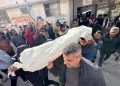
Dozens of Thousand of Palestinian people attended the funerals of those killed. Still, they were forced to mourn once again the following day, when Israeli occupation troops fired aimlessly into a crowd, killing 17-year-old Hatem Abu Sisi and wounding 16 others.
As Palestinian leaders gathered to discuss the escalating situation, protests and clashes broke out within the refugee camps, spreading rapidly across the West Bank and East Jerusalem. Palestinians took control of neighborhoods, barricading roads to prevent Israeli army vehicles from entering. Largely unarmed, they defended themselves only by throwing stones at the soldiers and their tanks. Shopkeepers closed their businesses, and laborers refused to go to their workplaces in Israel.
The Israeli occupation defined such acts as “rioting” and aggressively suppressed the protests by firing rubber bullets, live ammunition, and tear gas canisters into the crowds. The protests grew more extensive, involving tens of thousands of people, including women and children.
By December 12, six Palestinians had been killed, and 30 had been injured in the violence. Those rising against Israeli injustice were part of a generation that had been raised in the shadow of what remains a brutal military occupation; this opportunity to take a stand against the violations of their rights was not to be missed.
As the protests showed no signs of dissipating, Israel used mass arrests to dissuade people from taking part.
Universities and schools in the West Bank were closed; according to Professor Wendy Pearlman, curfews were enforced 1,600 times in the first year.
Palestinian farms and homes were razed, trees were uprooted, and protestors who refused to pay taxes had their properties and building licenses seized.
Illegal Jewish settler-colonists also launched regular attacks against the Palestinians; the latter threw stones in self-defense and faced settler brutality.
In the first year alone, 300 Palestinians were killed, 20,000 had been injured, and some 5,500 were detained by Israel, according to the UN Relief and Works Agency for Palestine Refugees (UNRWA).
The Swedish branch of Save the Children estimated that “23,600 to 29,900 children required medical treatment for their beating injuries in the first two years of the Intifada”; one-third were under ten.
Images played an essential part in how the international community perceived the Intifada as the asymmetry between the unarmed Palestinian protestors and the Israeli army was depicted in all its brutality.
One particular video caused outrage in 1988 when Israeli army personnel were filmed beating two Palestinian teenagers and deliberately breaking their arms. Israel’s image as the underdog, as the Jewish nation surrounded by hostile Arab neighbors, slowly reversed.
The violence of the Israeli occupation continues until this day. Dozen of thousands of Palestinians have been killed by the brutal Israeli occupation forces in the occupied territories and Gaza Strip. From 1989 to 1990, the United States continually vetoed UN Security Council draft resolutions that deplored Israel for its human rights abuses and non-compliance with the Fourth Geneva Convention.
Shortlink for this post: https://daysofpalestine.ps/?p=10417