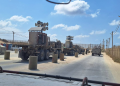
DayofPal– Contrary to longstanding allegations, none of the 110 incidents involving the looting of aid trucks in Gaza were carried out by Hamas, according to an Israeli military report cited by Channel 12.
The revelation emerged during a high-level military meeting aimed at assessing the situation on the ground in the Gaza Strip.
The report instead attributes the looting to Israeli-backed armed gangs and local organized clans, which, it claims, operate under the full protection of Israeli forces.
A senior Israeli military official present at the meeting stated plainly, “There is no famine in Gaza; we are not close to that point.”
Notably, the same report acknowledged that Israeli forces have repeatedly targeted Palestinian police units attempting to prevent such looting.
The United Nations World Food Programme (WFP) has echoed these findings. In an interview with CBS, WFP Executive Director Cindy McCain dismissed accusations that Hamas was stealing humanitarian aid.
“No, not at all,” she said when asked whether Hamas had looted 15 WFP trucks entering southern Gaza. “This doesn’t have anything to do with Hamas.”
According to the WFP, a convoy of aid trucks was en route to a warehouse in Deir Al-Balah when it came under fire. A police unit escorting the trucks confronted looters when Israeli warplanes launched eight consecutive airstrikes on the scene, killing six officers and injuring 20 others.
Local authorities in Gaza argue that these attacks reflect a broader Israeli policy aimed at destabilizing the Strip by deliberately obstructing aid delivery. Officials have accused Israel of using starvation as a weapon of war, an allegation supported by several human rights organizations.
Following the closure of Gaza’s main border crossings on March 2, Israel cut off access to food, medicine, and humanitarian supplies, precipitating what observers describe as an unprecedented humanitarian crisis.
Israel has repeatedly accused Hamas of diverting aid meant for civilians. Hamas, for its part, denies the claim, insisting that several of its members have been killed defending aid convoys from looters operating with Israeli protection.
A recent report from the Integrated Food Security Phase Classification (IPC) warns that nearly a quarter of Gaza’s population is expected to experience “catastrophic levels of food insecurity”—the highest alert level, IPC Phase 5—in the coming months.
After nearly 80 days of total blockade and mounting international condemnation, Israel announced roughly a week ago that it would allow a limited number of aid trucks to enter the enclave.
But aid organizations warn that these efforts are far from sufficient. “This is a drop in the bucket,” said McCain. “We have 50,000 people inside of Gaza that are extremely food insecure and could be on the verge of famine if we don’t help bring them from that.”
She contrasted current efforts with previous ceasefire conditions, under which “we were getting in 600 trucks a day. Right now, we are getting in maybe a hundred.”
The United Nations has confirmed that Israel continues to restrict the flow of humanitarian assistance, with only a small fraction of aid trucks allowed through.
UN Secretary-General António Guterres criticized the limited access, saying that Israel had only permitted what “amounts to a teaspoon of aid when a flood of assistance is required.”
Doctors Without Borders also condemned the inadequate aid, describing the current trickle of humanitarian relief as a “smokescreen” designed to “pretend the siege is over.”
Tom Fletcher, the UN’s Under-Secretary-General for Humanitarian Affairs, issued a dire warning: “14,000 babies are at risk of dying if humanitarian aid does not reach them”—a figure he called “utterly chilling.”
Shortlink for this post: https://daysofpalestine.ps/?p=63310