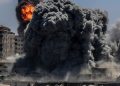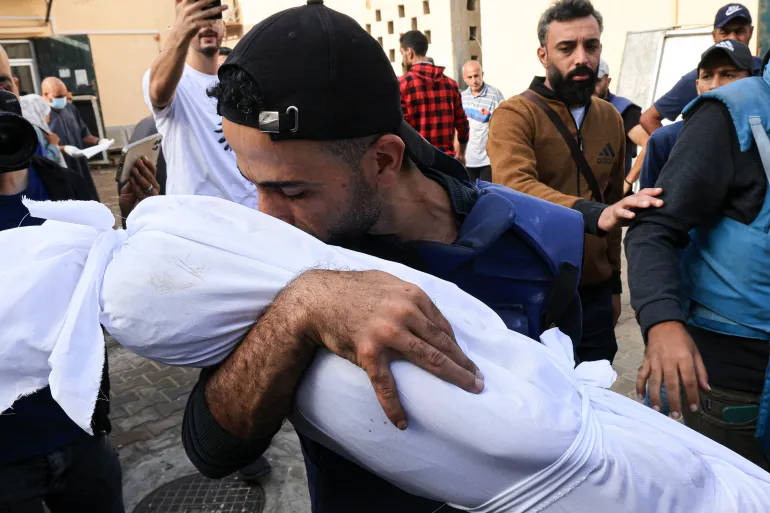
More than 1,000 Palestinians have been killed in the Gaza Strip since the US-brokered ceasefire agreement between Hamas and Israel took effect in October, underscoring the reality that for Gaza’s civilians, the killing and suffering have never truly stopped.
According to the Palestinian Ministry of Health, Israeli attacks have claimed the lives of at least 1,005 Palestinians since the agreement was announced, despite international claims that the war had entered a calmer phase.
“We mourn as Gaza reaches yet another tragic milestone,” said Fikr Shalltoot, Gaza Director at Medical Aid for Palestinians. “Thousands of people who were told the worst was over are still burying their loved ones.”
While the ceasefire reduced large-scale military operations, it failed to bring safety, accountability, or meaningful relief to Gaza’s population. The second phase of the agreement—which was expected to include an Israeli military withdrawal from the territory and broader political arrangements—has yet to be implemented.
Instead, Israel has expanded its control over Gaza. According to humanitarian reports, Israeli forces now control approximately 64 percent of the Strip, compared with 53 percent envisioned under the original ceasefire framework.
The expansion has been accompanied by new displacement orders. Last week, dozens of Palestinian families in eastern Gaza City were forced to flee their homes once again after Israeli forces extended the so-called “Yellow Line,” further shrinking the areas where civilians can remain.
Meanwhile, hopes that the ceasefire would pave the way for reconstruction have largely collapsed.
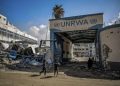
After nearly two years of destruction, Gaza’s healthcare system remains in ruins. According to humanitarian agencies, only 20 of Gaza’s 37 hospitals are partially functioning, while not a single hospital in the territory is operating at full capacity.
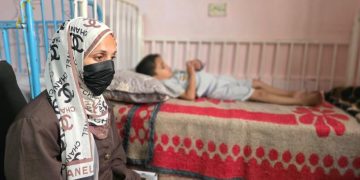
Medical supplies remain scarce, healthcare workers continue to struggle under impossible conditions, and thousands of wounded and chronically ill patients are unable to access adequate treatment.
“As the bombs continued to fall and Gaza remained under a near-total siege, world leaders convinced themselves that a piece of paper could replace accountability, lift the blockade, or deliver medicine to those who desperately needed it,” Shalltoot said.
She added that Gaza continues to face severe restrictions on aid access while humanitarian assistance is being manipulated and restricted as Palestinians endure worsening hunger and deprivation.
Since the beginning of Israel’s war on Gaza in October 2023, more than 73,000 Palestinians have been killed, according to Palestinian authorities. Entire neighborhoods have been reduced to rubble, and nearly 1.9 million people—almost the entire population—have been forcibly displaced, many of them multiple times.
For Gaza’s families, the so-called ceasefire has not brought peace. Instead, it has become another chapter in a continuing humanitarian catastrophe, where civilians remain trapped between ongoing attacks, displacement, starvation, and the absence of any meaningful protection from the international community.
Shortlink for this post: https://daysofpalestine.ps/?p=75479