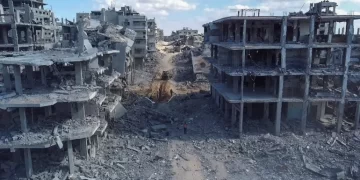
Gaza – In Gaza, hunger no longer whispers—it screams in silence. Children sleep on empty stomachs, mothers boil saltwater and call it soup, and families crumble under the weight of a famine born of Israeli blockade and sustained by global indifference.
The images from Gaza today are not of war alone—they are of quiet, hollow desperation. Of human beings starving, not because of drought or natural disaster, but because of a man-made blockade that has turned life itself into a privilege.
A Father’s Despair: “I Don’t Even Have One Shekel”
Saeed Al-Najjar, a father of eight displaced from northern Gaza, now counts his days in missed meals.
“We’re hours away from drinking water with salt,” he says. “Flour costs 110 shekels a kilo—and I don’t have a single shekel left.”
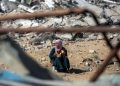
He describes watching neighbors—many of them elderly or mothers—collapse in the streets from hunger and exhaustion. Even hospitals, once sanctuaries, are now overflowing and unable to cope with the influx of the starving.
Boiling Salt and Spices: A Mother’s Fake Soup
Not far away, Rana Jaber has developed her own strategy to calm her children’s cries.
“I make fake soup—just water, salt, and a bit of spice—and tell them it’s food,” she says.
Rana hasn’t eaten bread in three days. The gnawing pain in her stomach keeps her from sleeping. “I try to stay strong for them,” she says. “But hunger is cruel. It makes you forget yourself. You just want the crying to stop.”
Medical Warnings: Bodies Collapsing, Children Fading
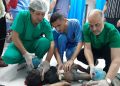
The Ministry of Health in Gaza has issued urgent warnings. Emergency rooms are seeing a sharp rise in patients suffering from malnutrition, including children too weak to cry.
“Thousands are at risk of dying if this continues,” a ministry official said in a statement. “Bodies are wasting away. People are collapsing in silence. We are past the point of crisis.”
690 Dead from Hunger. 71 Are Children.
The Government Media Office reports that 690 Palestinians have now died from hunger-related causes, including 71 children. These are not numbers—they are names that will never be called again, laughter that will never return.
Among those teetering on the edge is Maher Al-Sharafi, displaced from Gaza City’s Shuja’iyya neighborhood. He and his extended family of 50 now live as if on a hunger strike.
“We fast every day, not out of faith alone, but because we have no choice. We break our fast with a piece of bread, maybe a spoonful of lentils. Soon, it’ll just be water and salt. Like prisoners,” he says.
A Deafening Global Silence
This famine is not a byproduct of neglect—it is the result of a complete blockade. Entry of food, medicine, clean water, and fuel remains choked off. And while the world watches, Gaza’s families are reduced to pleading for basic survival.
Mothers don’t want politics. Fathers aren’t asking for speeches. Gaza is crying out for food, for open crossings, for the right to live.
The question now is not whether Gaza will survive, but how many must die before the world decides to act.
Shortlink for this post: https://daysofpalestine.ps/?p=66035