DayofPal– – The Israeli army’s ongoing assault on the occupied West Bank has displaced at least 26,000 Palestinians from their homes in the Jenin and Tulkarm refugee camps since last month, according to local officials and humanitarian organizations.
In Jenin, 17,000 people have been forcibly expelled from the refugee camp, which houses more than 24,000 registered Palestinian refugees, said Farha Abu al-Haija, a member of the Popular Committee in the camp.
The Israeli army has besieged, invaded, and bombed the area for the past two weeks, leaving thousands without shelter or basic necessities.
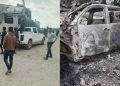
The UN agency for Palestinian refugees (UNRWA) reported that large parts of the camp have been completely leveled due to a series of Israeli detonations, estimating that at least 100 houses have been either destroyed or severely damaged.
On Sunday, Israeli forces rigged and blew up nearly 20 buildings on the eastern side of the camp, according to the Palestinian state news agency.
Israeli forces have restricted movement within the camp, forcing residents to flee under heavy shelling and explosions. In the vicinity, entire families have been expelled, with one demolished building alone displacing 200 residents.
With thousands now displaced, Palestinian families have been forced to take in up to 20 people each amid shortages of electricity, water, and other essential services.
“They are in shock by the magnitude of the raid. It is similar to what happened in Gaza, only this time it’s an area of just one square kilometer,” Abu Al-Haija said.
Many of those affected were already struggling financially before the assault, with residents unable to work for months due to previous Israeli military and Palestinian Authority-imposed sieges on the camp.
“Both the displaced families and the families who are receiving them are financially strapped. Prior to the Israeli military campaign, the camp was besieged by the Palestinian security services for 48 days. People have been without work for three months and have been unable to secure their basic daily needs, including food,” Abu Al-Haija explained.
Weeks before the Israeli offensive, the Palestinian Authority (PA) had launched a large-scale security crackdown in Jenin, besieging the city and clashing with local armed groups.
According to Abu Al-Haija, who also works with an organization providing psychological support to women and children, the extent of the destruction remains unclear due to the Israeli-imposed siege on the camp.
Residents say the current level of violence surpasses even the notorious 2002 Israeli invasion of Jenin during the Second Intifada.
The ongoing assault has been particularly devastating for children, who have been unable to attend school since early December. UNRWA spokesperson Juliette Touma confirmed that 13 UNRWA schools in Jenin and its surrounding areas have been closed, affecting around 5,000 students.
Abu Al-Haija reported that many children are experiencing severe psychological distress, with symptoms including heightened anxiety, involuntary urination, and episodes of hysterical screaming.
A Jenin resident described how her family fled their home amid the PA’s security operation. When they attempted to return, they found their house riddled with bullets, without water or electricity.
“I spent years building my house, but the amount of bullets that penetrated its walls and furniture is indescribable. I found some bullets in my children’s beds. If we’d stayed, they would have been killed immediately,” she said.
Her young daughter continues to suffer from overwhelming fear. “My daughter covers her ears whenever she hears the sound of bullets. I try to comfort her, but nothing helps,” she said, holding back tears.
“The residents of Jenin are cramped in small apartments, and their children cannot go outside to play for fear of snipers. Now, our only wish is for them to be able to play in the sun,” she added.
The Palestinian Health Ministry reported that at least 70 people have been killed by Israeli forces in the West Bank since the beginning of the year, including 10 children.
In parallel with its military operation in Jenin, the Israeli army has also launched an assault on the Tulkarm refugee camp, displacing at least 9,000 Palestinians. Many have sought refuge in community centers, clubs, and the homes of relatives.
Suhail Salman, an activist and political figure in Tulkarm, said Israeli forces have been deliberately targeting civilian infrastructure, residential buildings, and essential services such as water and electricity.
“The evidence for this is that the genocide in Gaza, the assault on the camps in the West Bank, and the attack on UNRWA are all happening simultaneously with the goal of evacuating the camps and creating an uninhabitable environment for the population by halting any development of life within them,” Salman told MEE.
Two Israeli laws that went into effect last week ban UNRWA’s operations in Israel and in “areas under Israeli sovereignty,” further complicating the humanitarian situation. Former U.S. President Donald Trump has publicly backed these moves.
“The spearhead of this attack on UNRWA is the Americans, and we heard Trump’s latest statements about the displacement of the people of Gaza to Egypt and the people of the West Bank to Jordan. So the process of displacement is ongoing,” Salman said.
He argued that the widespread destruction in the West Bank is intended to force Palestinian refugees to leave permanently.
“When the Israeli army blew up 20 buildings in the Jenin camp, it was filmed and broadcast on satellite channels. This is a blatant challenge to the whole world and the human rights system,” he said.
“It is clear that the world is reformulating itself so that Israel has the upper hand in the region.”
Shortlink for this post: https://daysofpalestine.ps/?p=60438