
DaysofPal- Israel has launched hundreds of airstrikes on different posts in Syria since Bashar al-Assad fled to Moscow on Sunday, claiming it is necessary for its security.
However, Israel has been attacking Syria with impunity since at least January 2013, when it bombed a Syrian weapons convoy, killing two.
Since then, Israel has attacked Syria continuously, typically claiming it was targeting positions belonging to its nemeses – Hezbollah and Iran.
According to observers, in the process, it has normalised the idea of attacking a neighbouring state.
A ‘penchant for destruction’
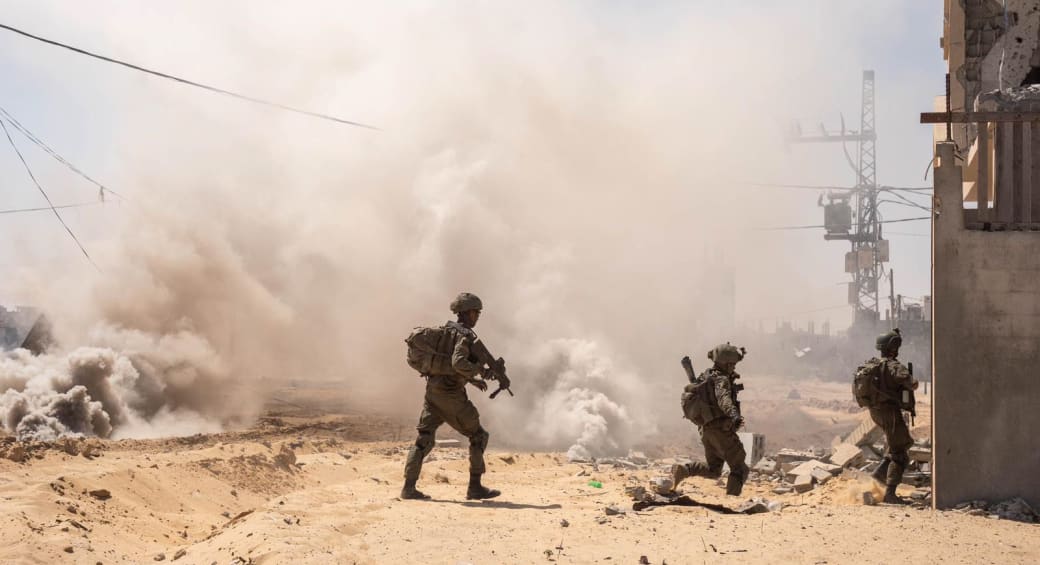
In the last few days, Israel has launched more than 480 air attacks on Syria.
At the same time, it has moved its ground forces into a demilitarized zone located within Syrian territory along the border with Israel in the Golan Heights, which Israel already illegally partially occupies. Israel says it wants to create a “sterile defense zone” and declared the 1974 agreement that had established the buffer zone “collapsed.”
Israel has denied reports in the media that its troops have taken control of Syrian territory
A national security adviser says US is in ‘deep consultation’ with Israel on Syria
It also struck 15 ships at anchor in the Mediterranean ports of Bayda and Latakia on Monday, about 600km (373 miles) north of the Golan Heights.
Claiming much of the credit for the lightning advance of the Syrian group, Hayat Tahir al-Sham (HTS), Israeli Prime Minister Benjamin Netanyahu said to journalists on Monday: “The collapse of the Syrian regime is a direct result of the severe blows with which we have struck Hamas, Hezbollah and Iran.”
The attacks on Syria, Mairav Zonszein, a senior analyst with the Crisis Group said, were “a mixture of both opportunism and strategy”.
That Israel should seek to neutralize a potential threat upon its border while it was, for all practical purposes, defenseless, was a “no-brainer”, but what the long-term plan might be is less certain.
“I think what we’re seeing in reality is the strategy that Israel’s been developing since October 7th: identify a threat or opportunity, deploy troops and then figure it out.”
But political scientist Ori Goldberg was not convinced any strategy was at play.
Instead, he said: “This is our new security doctrine. We do whatever we want, whenever we want, and we don’t commit,” he said from Tel Aviv.
“People are talking about Greater Israel and about how Israel is sending its tendrils into neighbouring countries. I don’t see it,” he said.
“I think this is mostly the result of chaos, and a newly—or not so newly—found [Israeli] penchant for destruction.”
Ignoring the world’s condemnations
Israel has killed at least 48,833 people over the past 14 months.
It has been striking Iran, its ally Hezbollah in Lebanon, then invading Lebanon, and now it is attacking Syria.
All the while assaulting the besieged enclave of Gaza, an assault found to be genocidal by several nations and international organizations and bodies.
Unconcerned with casualties, Netanyahu’s talk of “changing the face of the Middle East” has found ready echoes across much of the Israeli media.
On Wednesday, an opinion in The Jerusalem Post boldly stated: “In the last year, Israel has done more for stability in the Middle East than decades of ineffective UN agencies and Western diplomats.”
Various states have criticized Israel’s attacks on the newly liberated Syria, including Egypt, France, Iran, Iraq, Qatar, Russia and Saudi Arabia. On Saturday the 22-member Arab League issued a statement accusing Israel of seeking to “exploit Syria’s internal challenges”.
The United Nations, whose mandate to police the buffer zone between Syria and Israel runs till the end of this year, decried this breach of international law.
“The UN’s protests mean absolutely nothing,” Golberg said, suggesting that Israel’s repeated clashes with various international organizations were part of an overarching mood within the country.
“We want to stick it to the Man,” he said. “We want to show the ICJ and the ICC that we don’t care. That we’re going to do exactly what we want.”
On Wednesday, The Times of Israel columnist Jeffrey Levine characterized the past 13 months as a move towards “a New Middle East of Peace and Prosperity.”
In Levine’s vision, following the tectonic shifts of the last year or so, Syria would be free from the geopolitical maneuvering of the al-Assads, Iran would be free of its “theocratic regime”, the Kurds would be free to form their own state, and Palestinians would be free to establish a new ”homeland” in Jordan.
“I don’t think most Israeli people imagine they’re going to be popular in the region after this,” Israeli political analyst Nimrod Flashenberg said, though some sort of rapprochement may be possible with Syria’s Kurdish and Druze minorities.
“But I think they are hopeful of a Middle East where there will be less regimes hostile to Israel,” he said.
This piece was originally published by Simon Speakman Cordall on Aljazeera
Shortlink for this post: https://daysofpalestine.ps/?p=59361