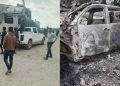
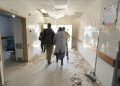
DaysofPal – During the course of Israel’s genocidal campaign in the Gaza Strip, entire dimensions of civilian life and shelter were devastated as Israeli occupation forces expanded their attacks beyond militants and civilians to include residential buildings and high-rise towers that housed thousands of families.
Over months of war, these towers became recurring targets, with their destruction unfolding alongside official Israeli statements linking the bombings to political objectives rather than urgent military necessity. The pattern, according to observers and rights groups, points to a policy that extends beyond combat operations toward forcibly reshaping Gaza’s civilian landscape.
Pattern of Deliberate Destruction
Among hundreds of residential buildings and towers damaged during the war, Amnesty International documented the destruction of at least 13 high-rise buildings in Gaza City between September and October 2025. According to the organization, each building was repeatedly bombed after residents had been forcibly evacuated.
The towers housed thousands of civilians, including displaced families, indicating that the attacks occurred in densely populated civilian areas rather than isolated military zones.
In a report Amnesty International said the destruction was not justified by imperative military necessity but instead formed part of a broader pattern of attacks targeting civilian infrastructure.
Erika Guevara Rosas, Senior Director for Research, Advocacy, Policy, and Campaigns at Amnesty International, stated that “all available evidence indicates that the destruction of these buildings was not required by military operations,” placing such acts within the scope of possible war crimes, including unjustified destruction and collective punishment.
Official Statements and Collective Punishment Allegations
Statements made by Israeli Defense Minister Israel Katz following some of the demolitions reinforced concerns about the nature of the attacks.
Katz directly linked the destruction to pressure on Hamas, declaring that “the gates of hell have opened” and threatening further devastation in Gaza if Israeli conditions were not met.
According to Amnesty International, publicly connecting the destruction of civilian property to political demands amounts to an acknowledgment that civilian suffering was being used as a pressure tool.
The organization also pointed to celebratory rhetoric surrounding the destruction of civilian structures, including universities and commercial towers, as evidence suggesting that the objective extended beyond military necessity toward imposing broad deterrent effects on the population.
Lack of Evidence for Military Targets
Although Israeli forces claimed that residential towers were being used for military purposes, no specific evidence was publicly presented to support those allegations.
Official Israeli statements repeatedly referred to “terrorist infrastructure” without providing documentation or detailed identification of military activity inside the buildings.
Meanwhile, Amnesty International said it analyzed satellite imagery and verified dozens of video recordings but found no evidence of military activity inside the targeted buildings at the time of the attacks. The organization also said it received no response to formal inquiries sent to the Israeli Defense Ministry regarding the nature of the targets.
The discrepancy between official claims and available evidence, Amnesty argued, raises serious concerns about the legality of the strikes, particularly under international humanitarian law, which requires direct and imperative military necessity to justify the destruction of civilian property.
Testimonies Describe Panic and Forced Displacement
Accounts from residents documented the chaotic evacuations that preceded many of the strikes. In most cases, residents said they received phone calls granting them only minutes to leave their homes.
Rather than providing safety, witnesses said the warnings triggered widespread panic.
A university professor who lived in one of the towers recalled that 76 families fled the building without being able to take any belongings, adding that his children continued to suffer psychological trauma after the evacuation.
Another resident described scenes of chaos and fear as families rushed to escape within a 20-minute window.
These testimonies suggest that the warnings were insufficient to ensure civilian protection and instead functioned as mechanisms of forced displacement carried out under extreme pressure and fear, a practice prohibited under international law.
Continuing Demolitions and Prevention of Return
Even after the ceasefire announced in October 2025, Israeli forces reportedly continued demolition operations in areas east of the “Yellow Line,” which covers more than 55 percent of Gaza’s territory.
Palestinians have reportedly been prevented from returning to these areas while bulldozing and demolition operations continue, reinforcing a new reality of geographic exclusion.
The destruction has also extended beyond these zones. Israeli airstrikes have periodically targeted remaining homes and partially damaged buildings across Gaza, including a recent strike in the Al-Shati refugee camp west of Gaza City, where a three-story house was bombed and the blast destroyed 30 nearby homes that had previously survived earlier attacks.
Amnesty International described this pattern as part of a broader policy aimed at subjecting civilians to harsh living conditions, including deprivation of shelter and humanitarian aid. Under international law, such acts may constitute prohibited conduct if linked to intent to partially or wholly destroy a population group.
Scale of the Destruction
Joint estimates by the World Bank, the European Union, and the United Nations indicate that Israeli attacks destroyed or damaged more than 371,000 housing units over two years, representing over 76 percent of homes across the Gaza Strip.
As a result, more than 60 percent of Gaza’s population has reportedly been left without permanent shelter.
Satellite imagery analysis further showed that by September 2025, approximately 83 percent of structures in Gaza City had been destroyed or damaged during the Israeli offensive, marking one of the most extensive waves of urban destruction in a short period of time.
The findings documented by Amnesty International, together with field testimonies and statistical data, present a coherent picture of residential towers being targeted as part of a systematic policy of destruction.
According to the report, the impact extends beyond physical devastation to include the dismantling of Gaza’s social fabric and the imposition of long-term displacement.
From a legal perspective, such actions may constitute serious violations of the Fourth Geneva Convention, which prohibits collective punishment and the destruction of civilian property absent imperative military necessity.
Rights organizations warn that without accountability, the pattern is likely to continue carrying long-term consequences for civilians and for the future reconstruction of Gaza.
Shortlink for this post: https://daysofpalestine.ps/?p=74624