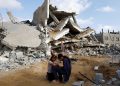
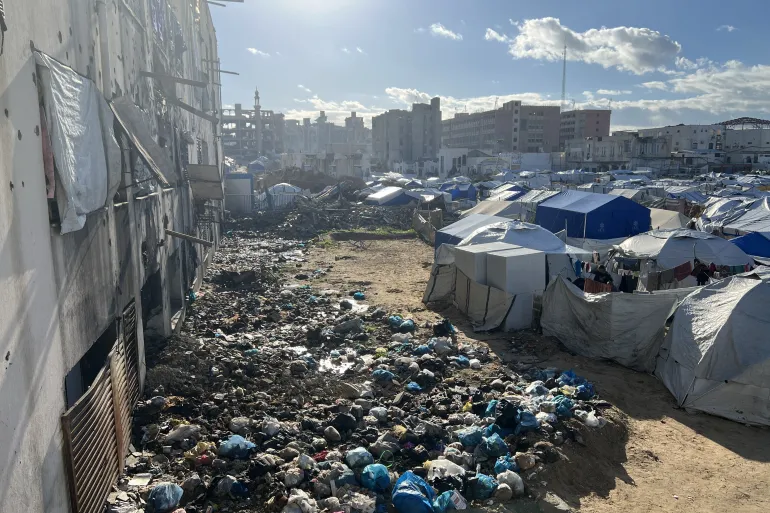
DayofPal– Displaced Palestinian families in Gaza are living in dire conditions, grappling with illness, pollution, and overcrowding after repeated displacement during the Israeli war.
The Abu Amr family, originally from Beit Lahiya, has been forced to displace more than 17 times. They now live in a tent beside a large rubbish dump in central Gaza City, where waste, sewage, and poor sanitation have become a constant threat to their health.
64-year-old Saada Abu Amr suffers from asthma exacerbated by the stench of nearby garbage, while her daughter-in-law, 35-year-old Suryya Abu Amr reports frequent cases of gastroenteritis among family members.
“My children suffer from mosquito bites and contaminated water during storms,” said Salem Abu Amr, describing how sewage frequently floods their tent.
His two-week-old daughter, Sabaa, has been bitten by mosquitoes, and his disabled father nearly died from a severe flu likely linked to rodent contamination.
Medical professionals warn that Gaza’s public health crisis is severe. Dr. Ahmed Alrabiei, head of pulmonology at Al-Shifa Medical Complex, said hospitals are overwhelmed, with bed occupancy at 150% capacity.
Viral and bacterial infections, gastroenteritis, respiratory illnesses, and autoimmune complications are increasing, particularly among children, the elderly, and those with chronic conditions.
Infrastructure damage has compounded the crisis. Ahmed Driemly, of Gaza Municipality, reported that over 150,000 meters of water pipes and 85% of water wells in Gaza City have been destroyed, alongside the city’s water desalination plant.
With 700,000 tonnes of waste piling up, including 350,000 tonnes in Gaza City alone, residents face health risks from insects, rodents, and contaminated groundwater.
Even with a US-backed ceasefire, reconstruction efforts are stalled by continued restrictions, leaving residents in unsanitary conditions for the foreseeable future.
Displaced families like the Jarad family from Jabalia struggle to access basic facilities. Rojan Jarad, mother of four, described using buckets in her tent for sanitation due to overcrowded and unsanitary public toilets in shelters.
“The lack of toilets has reshaped our daily life,” she said. “It’s humiliating, and we are constantly exposed to infections.”
With sanitation systems at risk of permanent collapse, Gaza’s displaced population faces a daily battle for survival in unsafe and unsanitary conditions.
Shortlink for this post: https://daysofpalestine.ps/?p=71620