DaysofPal- The prolonged closure of Gaza’s crossings by Israeli occupation forces has pushed the Strip’s healthcare system to the brink, leaving patients like thirteen-year-old Muhammad Mukhaimer struggling for survival.
Suffering from asthma, Muhammad desperately needs medication to help him breathe, but his family faces an insurmountable challenge: the lack of essential medicines due to Israeli blockade.
Every morning, Umm Muhammad, the boy’s mother, walks to the nearest UNRWA clinic in the Japanese neighborhood north of Khan Yunis camp, hoping to find her son’s life-saving treatment.
Each time, she is met with the same devastating response: “The crossing is closed, and the medicine has not entered yet.” The situation has become catastrophic since Benjamin Netanyahu announced the closure of Gaza’s crossings, cutting off the flow of critical medical supplies.
A Child’s Struggle to Take Breathe
Muhammad’s condition worsens daily, exacerbated by the dusty, smoky air from waste burning near their home in Khan Yunis camp. Without access to his prescribed medication, Salbutamol—a drug that opens the airways in his lungs—his health deteriorates rapidly.
He can no longer walk more than 50 meters without needing oxygen or medication.
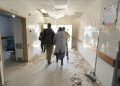
Desperate, Umm Muhammad takes her son to Nasser Medical Complex for vaporizer sessions, but even there, challenges persist. The hospital halls are overcrowded with patients suffering similar symptoms, and power outages further complicate care.
“Before the occupation closed Kerem Abu Salem checkpoint,” Umm Muhammad told Palestine newspaper, “we faced difficulty in obtaining Mohammed’s medicine, but at least he got it after suffering. Now, the situation has become catastrophic. My son needs daily vaporizer sessions, but electricity is not available, and the medicine is not available.”
She pleads with the international community to intervene immediately, warning that without urgent action, countless lives will be lost.
Elderly Patients Left Vulnerable
The suffering extends beyond children. Mahmoud Qannan, a 60-year-old man suffering from high blood pressure and diabetes, finds himself in a perilous situation. For years, he relied on monthly supplies of medication from the UNRWA clinic in Khan Yunis camp. However, since May 2024, the clinic has been repurposed to house displaced people, leaving him without access to vital treatments.
Qannan now turns to alternative medications from commercial pharmacies, which are both expensive and less effective. In recent days, the absence of key drugs for managing his conditions has led to sudden health problems, increasing his fear of a severe medical emergency at any moment. “I am constantly worried about my health deteriorating because I cannot get the medications I need,” Qannan said. The financial burden of purchasing substitutes adds to his distress amid Gaza’s dire economic conditions.
Eight Days of Closure, Endless Suffering
For the eighth consecutive day, Israeli occupation forces have maintained the closure of Gaza’s crossings under orders from Prime Minister Benjamin Netanyahu. This decision came despite the conclusion of the first phase of the ceasefire and prisoner exchange agreement, as Israel continues to obstruct negotiations regarding the second phase.
International relief agencies warn of the “limited” availability of food and medicine in Gaza, raising concerns about the potential spoilage of aid stranded at the border. With each passing day, the humanitarian crisis deepens, leaving Gazans to confront mounting despair and uncertainty.
As the world watches in silence, the people of Gaza face another grim reality: the systematic denial of basic necessities like medicine and healthcare.
Umm Muhammad’s plea resonates with millions who depend on international intervention to save lives. Without immediate action, the blockade threatens to claim countless more victims, turning what was once a preventable crisis into a tragic inevitability.
This is not merely a shortage—it is a policy of death. The global community must act decisively to demand accountability and ensure the safe passage of humanitarian aid into Gaza. Failure to do so condemns its people to unimaginable suffering.
Shortlink for this post: https://daysofpalestine.ps/?p=61283