DaysofPal – There’s nothing left for people here. One of the defining features for the hundreds of thousands of Palestinians returning to Gaza City and the northern parts of the Strip is no longer life; it is the sheer struggle to survive.
In this context, survival does not imply life. It means enduring. It means breathing amid the ruins of what used to be home, after two relentless years of bombardment that erased entire neighborhoods and left the land scarred and silent.
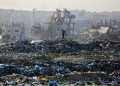
As families return, many walk through streets buried under rubble. Others drive slowly past what used to be their homes, now concrete shells, collapsed roofs, and mangled steel. Some find nothing but the faint trace of where their walls once stood. For many, even the idea of setting up a makeshift tent feels impossible; there’s simply no solid ground left to pitch it on. Those who manage often do so in the middle of roads, constantly at risk from the few passing cars that navigate the wreckage.
Children wander through debris, searching for fragments of their past, pots, school bags, family photos, anything that can connect them to a life that no longer exists. The sound of their small hands shifting through the rubble is the only movement in what feels like a dead city.
A week after the ceasefire, Palestinians returning to Gaza found not their homes, but the graves of their memories. Yet they came back. Despite the loss, despite the hunger and fear, they refused to be erased from their land.
For many, what awaited them was beyond comprehension. The coastal roads north of the city were filled with hundreds of people, families walking with the few belongings they’d managed to carry through one displacement after another. Mothers held children close, fathers dragged broken suitcases, and elderly people leaned on canes or each other.
When they reached their neighborhoods, shock met them like a wall. The north had been razed to the ground. Homes, schools, mosques—everything flattened, unrecognizable. “Upon arriving in Sheikh Radwan,” one father said, “I hoped to find my house standing, but I found the opposite. Everything was flat. I couldn’t even distinguish where my home once stood. The rubble of every house was mixed together. The destruction here is beyond imagination.”
He and his family sat among the ruins, tears falling quietly. “We lost forty years of memories,” he said. “The house is beyond repair. Not a single concrete pillar remained intact. Even the stones are shattered. It feels as if a nuclear bomb hit this place.”
For many families, the devastation left them with a cruel choice: stay amid the ruins or return south to overcrowded camps, where food, water, and medical care are painfully scarce. Yet despite everything, most chose to stay, to rebuild their lives on the same ground that has buried their past.
Electricity, clean water, and healthcare are nearly nonexistent. Streets remain blocked by the debris of homes, and schools that once echoed with children’s laughter now stand as hollow skeletons. But amid all this, something unbroken persists, a fierce attachment to the land, to the right to exist where generations before them once lived.
Shortlink for this post: https://daysofpalestine.ps/?p=68709