DaysofPal- For nine days, the family of Mohammed Abu Khamash suffered an agonizing wait to recover his body from an area east of Deir al-Balah that remained under Israeli military control, illustrating the difficulties Palestinians face in retrieving and burying those killed in parts of Gaza inaccessible due to ongoing Israeli military restrictions.
Abu Khamash was shot and killed by Israeli occupation forces in an area near the “Yellow Line.” His body remained where he fell after continuous gunfire and restrictions prevented ambulance and rescue teams from reaching the site.
The family appealed to international organizations and humanitarian agencies for urgent intervention repeatedly but could not recover his remains. Their requests were not answered until nine days after his death.
A Heartbreaking Retrieval
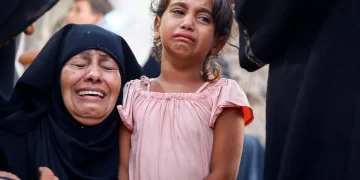
Throughout the ordeal, Abu Khamash’s mother was denied the chance to bid farewell to her son. When his remains were finally recovered, she received what was left of his body in a black bag after it had decomposed from prolonged exposure in the open.
His remains were later transferred to Al-Aqsa Martyrs Hospital before burial, bringing to an end a painful wait that had compounded the family’s grief.
During the days before the recovery, Abu Khamash’s father described the family’s anguish in a Facebook post, writing that his son’s grave had already been dug while his body remained only a few hundred meters away, beyond their reach.
He also recounted how the victim’s mother stood at the edge of the Israeli-controlled area holding a white flag, hoping she would be allowed to retrieve her son’s body.
The father said his son had suffered from a psychological illness and lamented that the family had been unable to recover his remains in time because of the conditions on the ground. He noted that similar circumstances had prevented other families from retrieving relatives killed in comparable locations.
In footage documented by journalist Osama Al-Kahlout, Abu Khamash’s mother was seen embracing what remained of her son’s head after receiving his remains. The images spread widely on social media, where many described them as a stark representation of the suffering endured by Palestinian families, whose hardship extends beyond the loss of loved ones to the prolonged wait to recover and bury their bodies.
Journalists and activists said the case reflects a recurring pattern in Gaza, where rescue operations are frequently prevented in areas where Israeli forces are deployed. Many described the incident as one of the most painful examples of the humanitarian consequences of restrictions that continue to obstruct medical and rescue teams from reaching victims.
Recovery delays becoming a regular reality
The case forms part of a broader pattern in which Palestinian families have struggled to retrieve the bodies of relatives because Israeli forces remain stationed in various parts of the Gaza Strip and continue to open fire in areas that rescue teams cannot safely access. These conditions have repeatedly delayed recovery operations and funerals.
Throughout the war in Gaza, ambulance crews and civil defense teams have faced persistent obstacles that have, in many cases, prevented them from reaching victims, forcing families to wait days before recovering the bodies of their loved ones.
Despite the ceasefire announced last October, Israeli attacks and restrictions on the entry of humanitarian aid have continued. According to official figures cited in the report, 1,098 Palestinians have been killed and 3,507 others injured since the ceasefire took effect, the majority of them women and children.
Shortlink for this post: https://daysofpalestine.ps/?p=76234