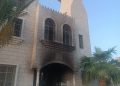
DaysofPal- Inside a partially damaged home in the Gaza Strip, the smell of freshly prepared sweets fills the air as Samira Touman moves between trays of kaak and maamoul, carefully preparing them for baking.
At 60 years old, the mother of seven works side by side with her daughters and daughter-in-law in the final days of Ramadan, determined to welcome Eid al-Fitr despite the hardships surrounding them. This will be the first Eid experienced in Gaza following the October ceasefire.
Samira kneads the dough with care, shaping each piece by hand while her daughter prepares fillings of date paste mixed with sesame. The process continues methodically until the trays are ready for the oven, where the most difficult stage begins. With no access to cooking gas, the family relies on a wood-fired oven, taking turns in front of the intense heat.
“This is the season of Eid, a season of blessings,” Samira said, wiping sweat from her forehead. “We are not celebrating the way we used to before the war, when I would bake until dawn, but we are doing what we can.”
The sweets are not only for her household. Neighbors and customers have placed small orders, offering the family a modest source of income during a time of deep economic strain.
“Demand is still there despite the high cost of ingredients,” she said. “People want to hold on to the feeling of Eid.”
Rising Costs and Daily Struggles
Preparations this year have been shaped by rising prices and shortages. Flour, semolina, sugar, ghee, and date paste have all become significantly more expensive following repeated closures of Gaza’s border crossings. Even when goods are available, many families struggle to afford them.
Samira recalled how her plans to buy ingredients were disrupted when crossings were shut again, driving prices even higher. “There is always something that takes away part of the joy,” she said. “Happiness exists here, but it is never complete.”
To keep baking, her son collects broken pieces of furniture from destroyed homes to use as firewood. The kitchen, once a place of order and comfort, has turned into a space marked by smoke and ash.
“We have forgotten what it means to work in a clean and organized kitchen,” she said. “Now everything is tied to fire and soot.”
Before the war, Samira ran a small home-based business, taking orders through social media and supporting her family with steady income. Her kitchen was fully equipped with modern appliances and tools.
“All of that is gone,” she said quietly. “Now we are starting again from nothing, working by hand, without the resources we once had.”
A Fragile Return Home
Like many families in Gaza, Samira and her relatives have endured repeated displacement. They returned to northern Gaza only a month ago after spending time in Khan Younis and the al-Mawasi area.
“Returning is only beautiful when your home is still livable,” she said, gesturing toward the damage surrounding her. “Here, everything is destroyed. There is no proper infrastructure, no water, nothing that makes life normal.”
Her hesitation to return was rooted in uncertainty. She feared that conditions would remain unstable, with restrictions on goods and sporadic attacks continuing despite the ceasefire.
“The bombing is less intense now, but nothing feels stable,” she said. “We live with constant uncertainty.”
Her daughter, trying to lift the mood, urged her to focus on celebrating Eid instead of discussing the hardships. Samira smiled, acknowledging how difficult it is to separate daily life from the realities of war.
“This year, we hope Eid brings better days,” she said. “We want stability, lower prices, and the return of basic supplies. We are tired of living like this.
Shortlink for this post: https://daysofpalestine.ps/?p=73124