DaysofPal- At least 22 Palestinians were killed, including journalists and medics, as footage reveals the second blast was two near-simultaneous tank shells.
However, newly obtained video evidence shows that the Israeli strike on Nasser Hospital in southern Gaza earlier this week was not a “double-tap” attack but in fact a triple strike, raising fresh concerns over the deliberate targeting of journalists, medical staff, and first responders by Israeli occupation forces.
The hospital, which is the largest still functioning in southern Gaza, was hit on Monday, August 25, by Israeli forces, killing at least 22 people, including five journalists, doctors, nurses, and civil defense workers.
The Israeli attack has drawn widespread international condemnation, with the UN Secretary-General, Doctors Without Borders (MSF), and press freedom groups calling it a war crime.
At 10:08 a.m., Reuters cameraman Hussam Al-Masri was livestreaming from the fourth-floor balcony of the hospital when a first Israeli shell struck the building’s exterior staircase, killing him instantly.
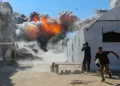
Within minutes, rescue teams and journalists rushed to the site; however, nine minutes later, as they attempted to recover the dead and wounded, two more near-simultaneous shells struck the same location.
A frame-by-frame analysis conducted by CNN shows the second “tap” was in fact two separate tank shells fired almost simultaneously, causing the bulk of the casualties.
“Journalists, patients, nurses, civil defense were on the stairs. We were directly targeted,” said Reuters contractor Hatem Omar, who survived with injuries.
Weapons experts told CNN the damage was consistent with M339 multi-purpose tank shells, suggesting a coordinated strike involving at least two Israeli tanks positioned northeast of the hospital.
Conflicting Israeli Accounts
On Monday, Israeli Prime Minister Benjamin Netanyahu called the incident a “tragic mishap,” expressing regret.
But by Tuesday, the Israeli occupation forces defended the strike, claiming it had targeted a “Hamas observation camera” monitoring troop movements.
It also claimed that six militants were killed, though evidence reviewed by CNN and local health officials deny this.
Gaza’s Health Ministry rejected the Israeli claims, saying the Israeli occupation had mislabeled civilian victims as combatants.
A Palestinian health official said that the Israeli forces are “pulling names from morgue records to justify the killings.”
Among the victims, the five journalists who were killed were identified as Hussam Al-Masri (Reuters contractor, father of four), Mariam Abu Dagga (freelance journalist, worked with AP and Reuters), Moath Abu Taha (freelance journalist, worked with AP and Reuters), Ahmed Abu Aziz (freelancer), Mohammad Salama (Al Jazeera cameraman)
Photos and videos from earlier this summer show that the balcony and staircase where they died had long been used by international media as a filming and transmission site, a fact well-known to the Israeli forces.
The Committee to Protect Journalists (CPJ) called the incident “one of the deadliest attacks on media workers in decades.”
Reuters and the Associated Press issued a joint protest letter demanding answers, stressing that the victims were clearly working in their professional capacity.
International law experts warned the strikes constitute disproportionate and unlawful use of force.
“It seems an extreme use of force by simply shelling the hospital to get this camera, not only once but twice,” said Hurst Hannum, emeritus professor of international law at Tufts University.
Meanwhile, Nasser Hospital staff warn they are on the brink of collapse.
“Medical staff and hospitals are supposed to be granted the highest level of protection under international law,” said Dr. Salah Mansour, a surgeon at the hospital.
“Yet here we are, pleading for our safety as healthcare workers.” He added.
Shortlink for this post: https://daysofpalestine.ps/?p=66957