In a place still bearing the scars of a long and devastating genocide, a single Christmas candle was lit inside Gaza’s Holy Family Church, turning prayer into an act of resilience. The Mass sent a clear message: Gaza’s people—across faiths and identities—remain rooted in their land despite destruction, siege, and repeated attempts at erasure.
The Christmas service was held at the Holy Family Church (Latin Monastery) in Gaza City in a quiet, reverent setting, attended by a small number of worshippers and clergy. It marked the first collective religious celebration since the ceasefire took effect, after months in which Israeli bombardment and mass displacement forced the suspension of public worship.
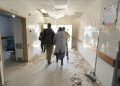
More than a religious ritual, the Mass became an assertion of presence. During the war, the church had served as a shelter for dozens of displaced families, both Christian and Muslim. Its outer buildings were damaged by nearby strikes, windows shattered, and walls cracked, while the surrounding area remained unsafe for long stretches of time.
Visit of Solidarity
The Mass followed a three-day pastoral visit by the Latin Patriarch of Jerusalem, Cardinal Pierbattista Pizzaballa, accompanied by Patriarchal Vicar Bishop William Shomali and several priests. The visit aimed to open Christmas celebrations, assess the needs of the Holy Family parish, and follow up on ongoing relief and early reconstruction efforts.
The delegation toured humanitarian projects and met with clergy and parish members, reaffirming the deep bond between Gaza’s Christian community and the Jerusalem Patriarchate. Children welcomed the visitors with simple Christmas songs and symbolic gestures, briefly restoring warmth and joy to a space long shaped by fear and loss.
The Patriarch said the visit felt different from those he made during the war. For the first time, he noted, there was space for calm, even as suffering remained visible. He stressed that hope persists through children, schools, and community life, and conveyed solidarity from churches and institutions around the world.
Beyond Survival
In his Christmas homily, the Patriarch emphasized that this moment must go beyond surviving the war and become a turning point toward rebuilding life. He urged the community to carry the spirit of Christmas—light, compassion, and care—despite the harsh reality.
He drew parallels between the birth of Christ in deprivation and the daily reality of Gaza’s residents, saying that God’s path has always been the path of the poor and the vulnerable. History, he added, is not shaped by empires or force, but by people’s choices and endurance.
Reconstruction, he stressed, is not limited to buildings or infrastructure. It begins with healing hearts, restoring trust, and reaffirming humanity—because love alone can repair what war has destroyed.
One Community
The Patriarch reaffirmed that Gaza’s Christians are not a temporary presence, but a rooted part of the city’s identity. He called for unity across communities to rebuild Gaza materially and morally.
As part of the visit, the delegation also stopped at Saint Porphyrius Greek Orthodox Church, reinforcing a message of Christian unity and shared suffering in Gaza.
Shared Pain, Shared Strength
The Christmas Mass reflected Gaza’s broader reality: unity forged through hardship. In a city where only a few hundred Christians remain—mostly Orthodox and Catholic—the pain is shared, and so is the struggle for dignity and life.
A joint statement issued by Christian leaders placed the celebration in a wider moral context, questioning how joy can exist while Gaza continues to endure the aftermath of war, hunger, disease, and displacement.
The statement warned that violence extends beyond Gaza to the West Bank, where arrests, killings, home demolitions, land seizures, and settler attacks are escalating. It affirmed that the message from Bethlehem, Jerusalem, and Nazareth is one of equality, justice, and hope, insisting that light will ultimately overcome darkness.
Faith Under Fire
During the war, the Holy Family Church became a refuge for displaced families after their homes were destroyed. Nearby strikes damaged its surroundings, injured civilians seeking shelter, and left the area unsafe for long periods.
Today, Gaza’s Christian community—numbering only a few hundred—faces the same crushing conditions as the rest of the population under siege. Yet holding Christmas Mass in such circumstances became a declaration of life.
In Gaza, Christmas was not simply observed. It was defended—quietly, humbly, and steadfastly—as an act of faith in a city that refuses to surrender its humanity.
Shortlink for this post: https://daysofpalestine.ps/?p=70613