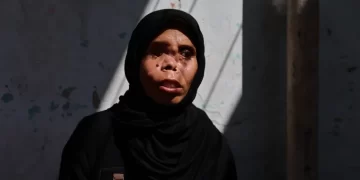
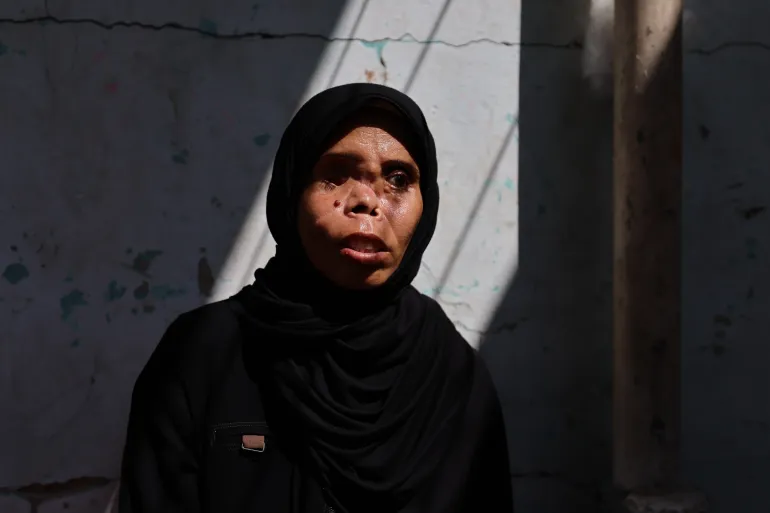
DaysofPal – After an Israeli airstrike hit her home in Gaza’s Nuseirat camp, 42-year-old Najwa Abu Atiwi spent weeks in a coma. When she finally opened her eyes in October 2024, her first desire was as simple as it was harrowing: she needed to see what was left of her face, sensing a profound loss she wasn’t yet fully able to measure.
“I kept asking to see what I looked like, but they would give me painkillers and medication to calm me down,” Najwa recalls.
Doctors eventually told her the truth. She had lost one eye, while the other had sustained internal bleeding and doctors were still trying to save it.
When she finally saw her reflection, she barely recognized herself.
“I looked at myself and did not recognize who I was. I felt as if I was looking at someone else, and I said, “Who is this?”
The physical trauma, however, was only the beginning.
A Loss Beyond Words
For nearly a month after regaining consciousness, Najwa repeatedly asked about her six-year-old daughter, Hajar, convinced she was safe. While in intensive care, she dreamed about her constantly and sought reassurance from relatives and medical staff.
No one told her the truth.
Only weeks later did she learn that Hajar had been killed in the same airstrike, just days before her sixth birthday.
Najwa never had the chance to hold her daughter one last time or say goodbye.
That grief has remained inseparable from the pain of her own injuries.
Najwa’s injuries required multiple surgeries and extensive reconstructive treatment. Surgeons inserted metal plates and surgical mesh into her face to repair severe fractures, but she still struggles to open her jaw, speak clearly, and eat.
“I still cannot eat normally,” she says. “My diet is limited to soups, water, juices, and milk.”
Doctors have referred her for specialized treatment abroad because several procedures she requires cannot be performed inside Gaza, where years of Israeli blockade and the destruction of the healthcare system during Israel’s war have left hospitals without the equipment and supplies needed for complex reconstructive surgery.
She continues to wait for permission to leave Gaza.
Among the Most Complex Cases
Dr. Ayman Saidam, a consultant in oculoplastic surgery, describes Najwa’s injuries as among the most severe cases he has treated.
She arrived with the complete loss of her right eye, multiple facial fractures, torn eyelids, and serious injuries around her remaining eye that prevented her from fully closing the eyelid, placing her vision at further risk.
According to Saidam, reconstruction in cases like Najwa’s must begin with rebuilding the facial bones before cosmetic procedures can even be considered.
“Eye cosmetic surgery in cases like these must first be built on maxillofacial reconstruction because cosmetic procedures alone cannot correct structural deformities,” he explains.
Throughout Israel’s war on Gaza, Saidam has treated patients suffering from shattered eye sockets, torn eyelids, facial tissue loss, severe burns, and injuries requiring complex facial reconstruction or eye removal.
Recovery often takes years and involves multiple operations before patients can receive an artificial eye or regain part of their former appearance.
While Gaza still has experienced surgeons capable of performing these operations, Saidam says the greatest obstacle is the chronic shortage of medical supplies.
“We have the knowledge and expertise, but the main problem is the lack of resources, equipment, and medical supplies,” he says.
Essential surgical materials, including specialized screws, implants, and eye medications, remain scarce, delaying treatment and prolonging patients’ suffering.
The Invisible Wounds
The psychological impact of facial disfigurement can be just as devastating as the physical injuries.
Dr. Hassan Abu Shawish, a psychologist at the Deir al-Balah Mental Health Clinic who treated Najwa, says her case involved multiple layers of trauma: surviving a devastating airstrike, losing her young daughter, and confronting permanent changes to her appearance.
Such experiences often lead to post-traumatic stress disorder, anxiety, depression, and body image disturbance, making it difficult for survivors to accept their altered appearance or return to normal social life.
Abu Shawish stresses that psychological care is an essential part of recovery, helping patients rebuild confidence alongside the physical reconstruction of their faces.
Najwa’s experience reflects a wider humanitarian crisis.
According to the World Health Organization, roughly one quarter of recorded injuries in Gaza are considered life-changing, while more than 50,000 injured people require long-term rehabilitation. Many have suffered amputations, severe burns, facial disfigurement, or other complex injuries caused by Israeli bombardment.
Holding on to Hope
Before the airstrike, Najwa lived an active life surrounded by family and friends. Today, she is trying to rebuild what remains while carrying the grief of losing her daughter and adjusting to a face she once struggled to recognize.
She describes Hajar as joyful, intelligent, and hardworking, adding that the little girl looked very much like her.
That resemblance makes the loss even harder to bear.
“I see my daughter in my dreams all the time,” Najwa says. “In my mind, my daughter is travelling and will return. Every day I ask: When will she come back?”
Despite everything she has endured, Najwa refuses to abandon hope.
As she waits for permission to leave Gaza and complete her treatment, she continues fighting to regain her ability to speak, eat, and live with confidence again.
“I want to return to my previous life,” she says, “and regain the beautiful personality I used to know in myself.”
Shortlink for this post: https://daysofpalestine.ps/?p=76583