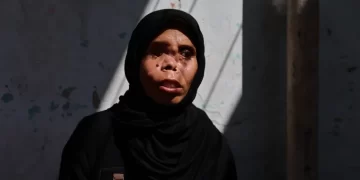
DaysofPal – The return of Hamada al-Banna alive has stunned families across the Gaza Strip, where thousands of Palestinians remain missing with no information about their fate.
Believing he had been killed during Israel’s war on Gaza, al-Banna’s family held a three-day mourning ceremony for him nearly a year ago. His unexpected return after a year in Israeli captivity has become a rare story of hope in an enclave where thousands of families continue searching for missing loved ones.
The Ministry of Health in Gaza reports that approximately 3,500 individuals have been officially reported missing. Palestinian rights organizations, including the Gaza-based Al-Dameer Association, estimate the number is closer to 9,500.
Two Months in a Coma, Four Months in Solitary
Al-Banna disappeared while trying to secure food for his family near the Zikim crossing in northern Gaza.
He said he had managed to obtain a bag of flour and was on his way home when he became separated from his brother, Adham Yasser al-Banna, in the massive crowds gathered around aid deliveries.
“I was going home carrying a bag of flour,” al-Banna recalled. “I was happy that I had managed to get it. Then someone called me and said, ‘Your brother has been killed.'”
Only a month earlier, he had lost another brother, Amjad, and initially refused to believe the news. But after the caller insisted, he dropped the flour and rushed to search for Adham.
“Suddenly, there was another huge explosion,” he said. “I was wounded in my legs, my hands, my chest, and my abdomen. My whole body was injured.”
He lost consciousness and awoke two months later from a coma at Soroka Medical Center in Beersheba, where he remained hospitalized for six months before being transferred to an Israeli prison.
Al-Banna said he spent the following four months in solitary confinement.
“Of course, I saw torture and suffering,” he said. “No matter how much I tell you, I won’t be able to describe what I went through. For me, death felt better than remaining under the torture and suffering I was witnessing.”
While al-Banna remained in Israeli custody, his family had no information about his whereabouts.
His fiancée, Reem Jadallah, refused to give up hope and sold her gold jewelry to hire a lawyer to search for him after repeated attempts to obtain official information failed.
After six months of inquiries, the lawyer informed the family that al-Banna had been killed.
Believing the information was accurate, the family held a three-day mourning ceremony roughly two months before his eventual release.
About two weeks ago, al-Banna was freed from Israeli detention. His first call was to his father.
“I said, ‘Dad, it’s Hamada,'” he recalled. “He replied, ‘Who is Hamada? My son was killed. We held a three-day mourning ceremony for him.'”
“I started crying and kept telling him, ‘It’s Hamada.’ He said, ‘Are you telling me you’re alive? My son was killed. Are you making fun of me?'”
Al-Banna called again, instructing his father to send a car to the port because he was arriving with the International Committee of the Red Cross.
When he finally reached home, his mother fainted in his arms.
Trauma after captivity
“Even now, every day, she looks at me and says she can’t believe I’m here,” he said. “She tells me, ‘My son, we held a mourning ceremony for you. We had lost hope of ever seeing you again, just like your brothers who were killed.'”
Although he has returned home, al-Banna says the physical and psychological effects of his detention remain.
“When I sleep, I dream that I am still in prison,” he said. “Every day, I pull shrapnel out of my body. My leg hurts, and so do my testicles, my heart, everything.”
“Yes, I am free now, but I am not the person I used to be.”
Thousands still missing
Al-Banna’s return remains an exception for thousands of Palestinian families who continue to wait for news of missing relatives.
Among them is the family of Nafez Abed, whose fate remains unknown.
“Waiting to learn the fate of a prisoner is more painful than receiving news of their death,” his mother, Aziza Abed, said, describing the anguish of living between hope and uncertainty without any official information.
His wife, Shaimaa Jundiya, said his absence has left an irreplaceable void for their four children.
She said they miss him in every aspect of daily life, adding that their daughter constantly prays for his safe return and watches with sadness whenever she sees fathers carrying their children in the street.
Across Gaza, families of the missing continue to organize sit-ins, holding photographs of their loved ones and demanding that their fate be disclosed.
Abdullah Qandil, director of the Waed Association for Prisoners and Ex-Prisoners, said thousands of families have appealed to international organizations to pressure Israel to provide information about Palestinians who disappeared during the war.
He said the continued lack of information “exacerbates the psychological and humanitarian suffering” of families forced to live between hope that their relatives are alive and fear that they may never return.
Shortlink for this post: https://daysofpalestine.ps/?p=76577