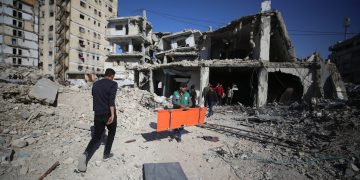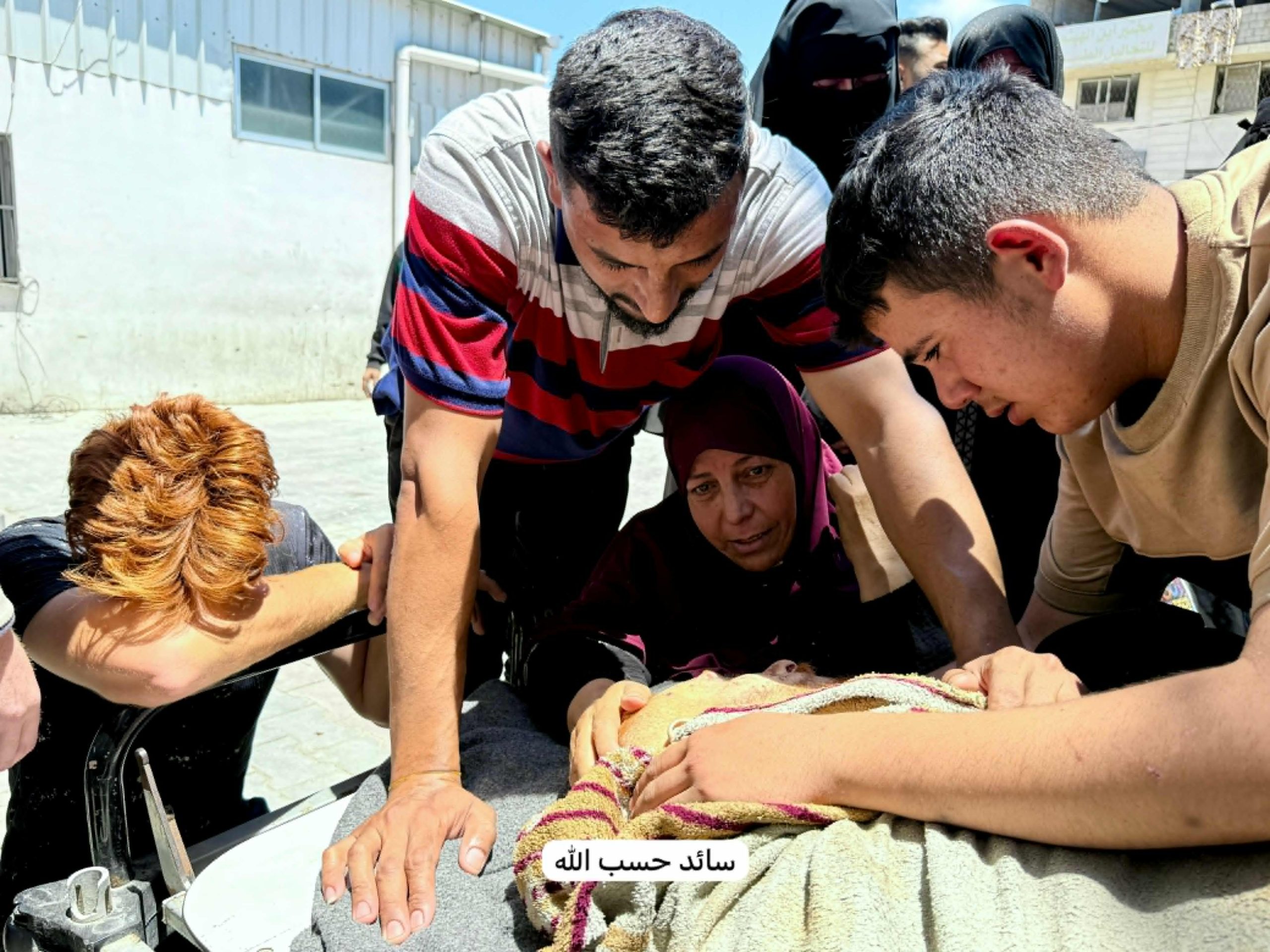
DaysofPal – The latest attack on civilian institutions in the enclave came Thursday despite the continued ceasefire, when an Israeli assault on the Jabalia refugee camp in northern Gaza killed the director of a police station and several police officers.
The attack comes amid a continuing pattern of Israeli military raids across Gaza, which Israel says target Hamas fighters and “imminent threats.” However, Palestinian and international analysts argue that the repeated attacks on police officers, medical personnel, academics, and government officials point to a broader strategy aimed at dismantling Gaza’s civilian infrastructure and preventing any meaningful post-war recovery.
Analysts say Israel has increasingly normalized daily military operations despite the ceasefire, carrying out strikes that have steadily increased the civilian death toll while undermining public administration and essential services.
According to Gaza’s Government Media Office, Israel has committed 3,689 ceasefire violations over the past 275 days, resulting in the killing of 1,122 Palestinians and the injury of 3,599 others. The office also said humanitarian conditions continue to worsen, with only 35 percent of the expected humanitarian aid trucks and 36 percent of approved travelers allowed to cross into the territory.
The cumulative death toll in Gaza since October 2023 has reached more than 73,000 Palestinians, with over 173,000 injured, according to health authorities.
The United Nations Human Rights Office (OHCHR) has also documented a pattern of attacks against police officers, describing them as essential to maintaining public order and facilitating any future reconstruction efforts. Since January 2026, the agency has recorded at least 12 attacks on police personnel, killing 35 officers, including several who were directing traffic or securing public markets.
One of the deadliest incidents occurred on May 23, when an Israeli strike on a police checkpoint in Gaza City killed at least five officers.
Health, Education and Leadership Devastated
The targeting extends beyond law enforcement. Much of Gaza’s healthcare system has been destroyed through repeated attacks on hospitals and medical facilities, while numerous doctors, nurses, and emergency workers have been killed.
The education sector has suffered similar losses. According to the Palestinian Ministry of Education, at least 441 teachers and education staff have been killed, alongside more than 11,000 students.
Gaza’s academic community has also sustained heavy losses. At least 117 academics have been killed, including renowned mathematician and president of the Islamic University of Gaza, Sufyan Tayeh, who was killed along with members of his family in an Israeli strike on Jabalia refugee camp.
Palestinian writer and political analyst Ahmed al-Tanani said Israeli justifications for these attacks have shifted from responding to immediate security incidents to carrying out preemptive killings based on alleged future threats.
He argued that recent strikes against police officers and civil servants intensified after Hamas showed political flexibility by agreeing to dissolve its governmental administrative committee in Gaza, suggesting that Israel’s objective extends beyond confronting Hamas itself.
According to al-Tanani, the continued attacks seek to weaken Gaza’s entire national and social structure by creating conditions of permanent instability, insecurity, and institutional collapse.
Political analysts say the broader objective is to prevent the establishment of effective Palestinian governance while preserving Israeli military control over the territory.
Israeli affairs expert Mohannad Mustafa argues that Israel is pursuing this strategy through three parallel measures: maintaining daily military strikes under the framework of the ceasefire, expanding its military presence inside Gaza while systematically destroying infrastructure, and obstructing political transition by preventing reconstruction efforts and limiting humanitarian access.
He said these policies effectively keep Gaza under permanent military management rather than allowing a political solution to emerge.
The strategy, analysts say, has also undermined efforts to implement the United States-backed post-war governance plan known as the Board of Peace, which was intended to oversee Gaza’s administration, reconstruction, and eventual deployment of an international peacekeeping force.
Paolo von Schirach, president of the US-based Global Policy Institute, said the initiative has failed to materialize because the proposed governing body lacks both the authority and the security capacity needed to assume control of the territory.
He argued that continued Israeli military operations have prevented the board from carrying out its intended role, leaving the broader political transition effectively stalled.
The Paralysis of the ‘Board of Peace’
The ongoing destruction has effectively neutralized the Board of Peace, a transition-and-governance body championed by US President Donald Trump to oversee post-war peacekeeping, disarmament, and administration.
“The Board of Peace was supposed to gradually take the reins, control the Strip to establish a form of governance… and eventually bring in a peacekeeping force to maintain order, thereby removing the Israeli army and disarming Hamas,” von Schirach explained. “None of that has happened, or is happening.”
Currently, the board lacks the operational tools, security mandates, and international backing required to assert administrative control, leaving the US-led diplomatic initiative at a standstill. While Washington’s attention has been partially diverted by brewing geopolitical crises in the Strait of Hormuz, its inability to enforce compliance on its close ally has become increasingly glaring.
Mustafa suggests this is not merely a lack of American diplomatic leverage, but rather an alignment of core objectives. Both the US and Israel agree on the necessity of disarming Hamas, differing primarily on the severity of the methods. “Israel is encouraged by the Board of Peace itself adopting the Israeli position regarding linking the entire agreement to disarmament,” he said.
Dismantling Pretexts: Palestinian Diplomatic Maneuvers
To break the administrative deadlock and test international resolve, Palestinian factions have actively pursued diplomatic adjustments. In a significant move, Hamas dissolved its governmental administrative committee in Gaza, signaling a willingness to hand over local governance to an independent, technocratic national body.
According to al-Tanani, Palestinian leadership is coordinating closely with mediators in Egypt, Qatar, and Türkiye to build a unified Arab and Islamic coalition. This bloc aims to pressure the United States to move past broad rhetorical support for a “ceasefire” and actively enforce the specific, operational parameters of the transition plan.
“This requires translating statements and positions into practical measures to pressure Israel to end the humanitarian catastrophe,” al-Tanani concluded. Until international guarantors transition from diplomatic statements to binding enforcement, analysts warn that Gaza remains trapped in a calculated loop of structural collapse and creeping annexation.
Shortlink for this post: https://daysofpalestine.ps/?p=76385