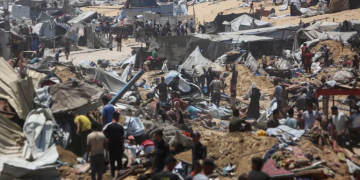
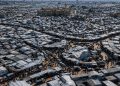
DaysofPal- The systematic flattening of Gaza’s agricultural heartland since October 2023 has done far more than alter the geography of the enclave; it has dismantled the very foundation of its food security. Once-thriving farming hubs like Sheikh Ijlin, remembered by local farmers through the bittersweet archives on their mobile phones, have been utterly reduced to barren dirt.
This comprehensive erasure of fields, wells, and orchards presents a dual catastrophe for displaced agriculturalists, who find themselves stripped of both their shelter and their livelihoods in a single blow. As a suffocating siege completely chokes off the entry of essential farming supplies, this widespread destruction has emerged as a central driver of the artificial famine endangering over two million lives.
Looking through old photographs on his mobile phone, farmer Abu Fares remembers when Gaza City’s Sheikh Ijlin neighborhood was known for its flourishing vineyards, fig orchards, and seasonal crops.
Today, those images bear little resemblance to reality.
Yet despite the devastation, many displaced families are attempting to reclaim a measure of self-sufficiency by cultivating small plots of land beside their tents. One displaced farmer says she now grows tomatoes, eggplants, peppers, and molokhia to feed her family, including several orphaned children under her care.
Farming as a Means of Survival and Resistance
Despite acute shortages of water, seeds, and agricultural supplies, farmers like Abu Mohammed continue to cultivate whatever land remains accessible, viewing agriculture not only as a livelihood but also as an act of resilience and attachment to their land.
The Ministry of Agriculture in Gaza stated that the amount of land under cultivation has fallen to less than 15 percent of its normal productive capacity as a result of the destruction of irrigation systems, the lack of inputs for farming and repeated attacks on farmers working in their fields.
Access to many former farmlands has effectively become impossible. Large agricultural areas have been incorporated into what Israeli forces designate as the “Yellow Line,” exposing anyone attempting to reach them to artillery fire and making cultivation potentially fatal.
As a result, for many displaced farmers, growing vegetables in small patches of soil surrounding their tents has become the only remaining option.
Food security experts warn that the destruction extends beyond the immediate effects of military operations.
Fadel El-Zubi, a food security expert and regional policy adviser at the UN Food and Agriculture Organization (FAO), argues that Gaza’s food production system has been systematically targeted. He says the destruction of wells, irrigation networks, food storage facilities, and perennial fruit trees has dismantled the foundations of local food production, leaving the population increasingly dependent on humanitarian assistance.
Before the war, agriculture contributed around 10 percent of Gaza’s economy and provided livelihoods for more than 560,000 people. Today, that system has largely collapsed.
Beth Bechdol, Deputy Director-General of the FAO, has warned that the widespread destruction of greenhouses and irrigation infrastructure has virtually halted local food production, significantly increasing the risk of famine across the enclave.
Agricultural Collapse in Numbers
Recent assessments illustrate the scale of the destruction. Joint geospatial analyses conducted by the FAO and the UN Satellite Centre in May 2025 found that less than five percent of Gaza’s cropland remained available for cultivation. By October, the UN agency for Palestinian refugees (UNRWA) reported that most agricultural land had either been destroyed or rendered inaccessible.
According to Gaza’s Government Media Office, more than 94 percent of the enclave’s 178,000 dunams of agricultural land has been destroyed, causing annual agricultural production to collapse from 405,000 tons before the war to just 28,000 tons.
The damage extends across nearly every part of the agricultural sector. Up to four million fruit trees, including 1.6 million olive trees, have reportedly been uprooted, losses that will take decades to reverse. At the same time, 87 percent of agricultural wells and 85 percent of greenhouses have been severely damaged or destroyed.
Direct losses to Gaza’s agriculture and livestock sectors are now estimated at $2.8 billion.
Rebuilding the sector will require substantial international support. Last year, the FAO launched an emergency appeal seeking $75 million to provide farmers with seeds, livestock feed, irrigation equipment, and other essential production inputs. However, according to El-Zubi, less than 10 percent of the requested funding has been secured, a shortfall he attributes to shifting international donor priorities amid multiple global crises.
Despite overwhelming challenges, scarce resources, and the constant dangers surrounding agricultural work, Gaza’s farmers continue planting whatever they can, determined to preserve a profession that once formed the backbone of the enclave’s economy and remains, for many, a symbol of survival and hope.
Shortlink for this post: https://daysofpalestine.ps/?p=76110