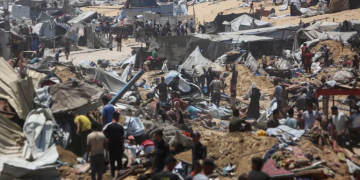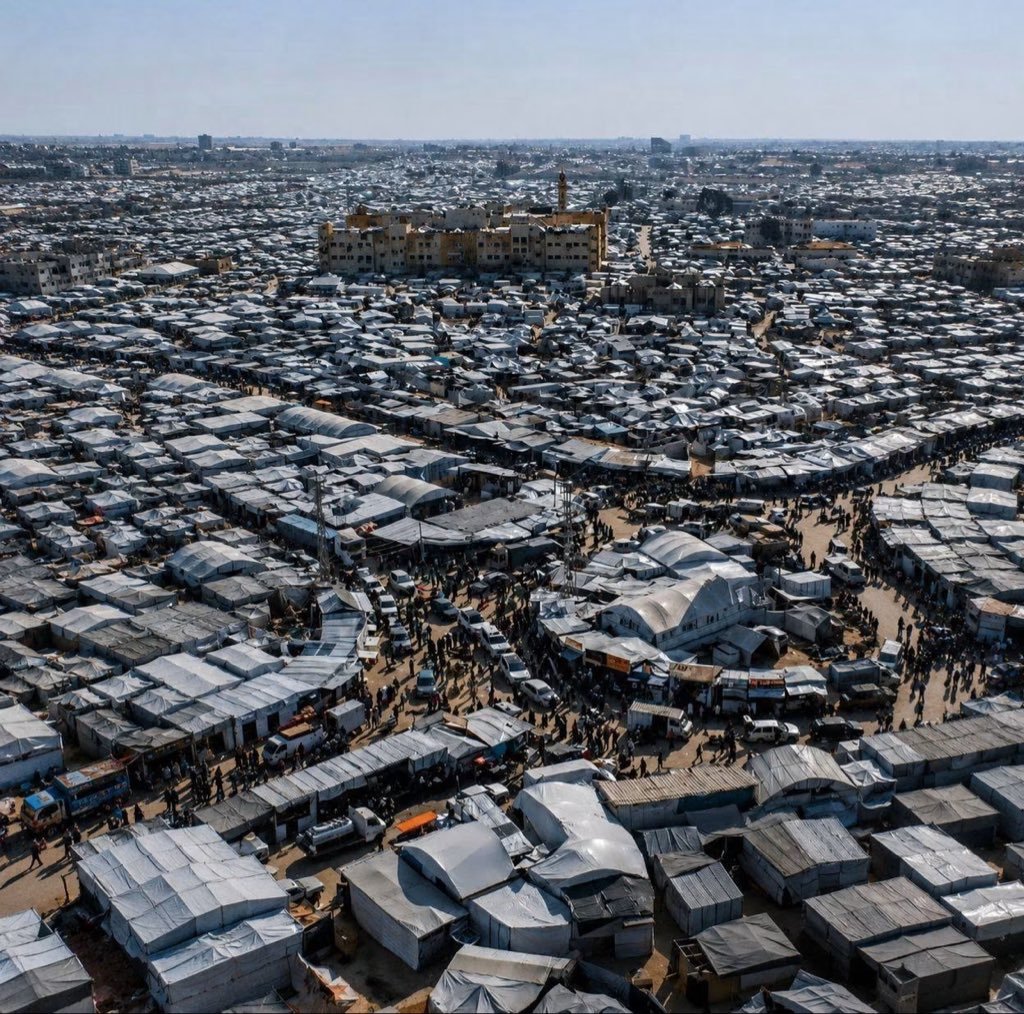
DaysofPal- For the third consecutive year since the outbreak of the Israeli genocidal campaign in October 2023, the concept of a “summer holiday” has been utterly redefined for the children of Gaza. Across the enclave, where destroyed infrastructure and mass displacement have turned daily life into a brutal test of endurance, the traditional hallmarks of summer, recreation, travel, and play have been replaced by a singular focus: survival.
Instead of attending summer camps, taking family trips, or unleashing their energy through sports, children now spend their vacation days performing exhausting physical labor.
Faten Nabhan, 35, is sitting with her six school-age children in a partially destroyed building in western Gaza City, taking a break after spending the morning filling water containers from trucks serving displaced families.
Like many parents across Gaza, Faten wants to fill her children’s summer holiday with activities that are both enjoyable and educational. But after nearly three years of war, she says there is little left to offer.
After more than 73,000 Palestinians have been killed, including thousands of children, while much of Gaza has been destroyed and most of its population displaced, daily life has become centered on meeting basic needs.
Each morning, children queue for water, collect meals from community kitchens, gather firewood for cooking, and help their families navigate life in displacement camps.
“This is my children’s routine every day. This is all they do,” Faten says.
A Childhood Without Play
Faten says her children, like thousands of others in Gaza, have been stripped of opportunities for recreation, self-expression, and emotional relief.
“There are no activities, no summer camps, no drawing, no colors, nothing at all,” she says. “All I can do is have them memorize a few parts of the Quran. That’s as much as I can manage.”
She explains that parents still have ideas for enriching their children’s summer, traditionally a season for play and developing new skills, but the resources have disappeared.
“There are no supplies, no toys, no notebooks, no crayons, not even paper and pens,” she says.
Since her husband, Raafat, was killed in an Israeli airstrike on their home in the Jabalia refugee camp in October 2024, Faten has been raising the children alone.
“I can barely feed my children and provide their basic needs,” she says.
In the absence of their father, her children have assumed responsibilities well beyond their years, taking turns fetching water, collecting firewood, and helping with household tasks.
“I feel deep sorrow that they’re spending their childhood this way. This is a time for play, not responsibility,” she says.
Faten also says there are virtually no community or institutional initiatives offering psychological support or recreational activities for children in the displacement camps during the summer break.
“Our children live in a forgotten corner of the world,” she says. “Every day I see loss and sadness in their eyes. Even play—the simplest of their needs—is missing.”
Her experience reflects findings by international organizations monitoring children’s welfare.
A UNICEF assessment published in May concluded that young children in Gaza lack safe and stimulating environments essential for healthy development, while older children continue to suffer from prolonged interruptions to their education, limited opportunities for recovery, and worsening social and psychological well-being.
Earlier this year, UNICEF’s Chief of Communications in Palestine, Jonathan Crickx, stressed that play is “not a luxury” for children living through war.
“Play is how children reclaim what war stole from them,” he said.
One Day of Joy in an Otherwise Endless Routine
For 41-year-old Asmaa Saleh, another displaced mother living in Gaza with her five children, preserving a sense of normal childhood has become a daily struggle.
Throughout the war, she has moved repeatedly in search of safety while trying to keep her children, aged between eight and 17, connected to learning.
She encourages them to memorize Quranic verses and recently succeeded in securing places for two of her children at a summer camp organized by a local charity. The camp meets only once a week, but its impact is profound.
“On camp day, they wake up early with unusual excitement,” Asmaa says with a smile. “They rush to shower, fix their hair, and get dressed. Sometimes they even skip breakfast because they’re so eager not to be late.”
For the remaining six days of the week, however, the routine rarely changes. The children spend their time eating, helping with cooking and washing, kneading dough, fetching water, and carrying out chores inside the family’s tent.
The Cost of Confinement
Having previously worked as a UNICEF case manager, Asmaa says the contrast in her children’s behavior highlights the importance of organized activities.
“Group activities during the holidays help develop children’s intelligence, emotional well-being, cooperation, and social bonds,” she says. “But staying confined inside a tent with no outlet creates tension that often turns into arguments and aggression among siblings.”
She points to her third daughter, who was unable to attend the camp, as an example. Unlike her older sisters, who return home cheerful and energized, the younger girl often displays signs of frustration and conflict.
For Asmaa, the difference underscores the value of play and education—rights guaranteed to every child under international conventions.
“Today, children in Gaza are being deprived of these rights at the very moment they should be enjoying them in their simplest forms,” she says.
Determined to create moments of normalcy, Asmaa recently received a small box of crayons and drawing paper from a charitable organization. She now spends part of each afternoon drawing and coloring with all of her children.
“I try to do anything to make good use of their summer,” she says. “I keep going because I can see the psychological difference that even one hour of organized play and drawing makes in their lives.”
Shortlink for this post: https://daysofpalestine.ps/?p=76107