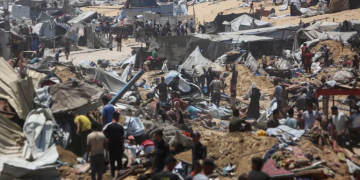

DaysofPal- The absence of electricity in the Gaza Strip is no longer merely a disruption of basic services; it has become a force that intensifies the hardships of daily life. As summer temperatures soar, families already exhausted by months of war find themselves trapped between tents that turn into ovens during the day and camps engulfed in darkness at night. For most residents, access to electricity has become an unaffordable luxury.
Over recent months, many Palestinians have searched for alternative sources of electricity to compensate for the prolonged power outage. Yet these solutions remain beyond the reach of most households.
Private generators require expensive fuel, while solar energy systems demand investments that are impossible for families who have lost their incomes during the war.
Umm Ibrahim, a displaced woman living in Gaza City, says that securing just a few hours of electricity now consumes a significant share of her family’s limited resources. She explains that electricity generated through private generators costs around 35 shekels per kilowatt, a price that most families cannot afford on a daily basis.
Tents Scorched by the Summer Heat
Even basic tasks such as charging mobile phones or running fans and essential household appliances require careful planning and long waits. “Electricity has become a necessity for survival, not a luxury,” she says.
In the al-Mawasi area west of Khan Younis, displaced resident Alaa Abu Shamala lives in a tent with no means of cooling. During the hottest hours of the day, he moves from one patch of shade to another to escape the sweltering heat, as the tent turns into “an oven” by midday.
He says there are no generator-powered electricity networks in the area, leaving solar energy as the only available alternative, one that remains inaccessible to many families.
“The heat inside the tent is unbearable,” he says. “It feels like we’re trapped inside a room on fire, with no way to cool it down.”
Power Cuts Threaten Livelihoods and Deepen Nighttime Hardship
The electricity crisis extends far beyond households, affecting workers whose livelihoods depend on reliable power.
Alaa, who works as a barber, says his greatest concern is keeping his hair clippers charged. Battery-powered clippers have become both scarce and prohibitively expensive, with prices rising from around 100 shekels before the war to nearly 3,000 shekels today.
If his clippers stop working or run out of charge, he says, he is forced to stop working altogether, cutting off his family’s only source of income at a time of severe economic hardship.
After sunset, displacement camps enter another stage of suffering as pathways and open spaces are swallowed by complete darkness due to the absence of public lighting.
Samer al-Attar, a displaced resident living in a camp in Gaza City, says moving around at night has become increasingly dangerous, particularly for children and the elderly.
“We use the light from our phones to get around,” he says. “But once the battery dies, we can’t see anything. Even taking children to the toilets requires someone to accompany them because of the darkness, stray dogs, and the rats roaming the camp.”
Al-Attar adds that he lost his job after the factory where he worked shut down because of the war. Installing a solar energy system is no longer a realistic option, he says, as the prices of solar panels and batteries have skyrocketed while thousands of people have lost their sources of income.
For many families across Gaza, electricity is no longer simply a public service; it has become an unattainable necessity, further compounding the hardships of displacement, poverty, and life under war.
Shortlink for this post: https://daysofpalestine.ps/?p=76104