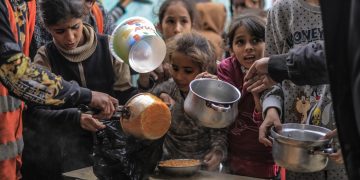
DaysofPal- United Nations agencies have warned that the Gaza Strip is at renewed risk of famine as the ongoing Israeli genocidal war approaches its 1,000th day and humanitarian conditions remain fragile despite a ceasefire agreement reached months ago.
In a recent joint report, the UN Food and Agriculture Organization and the World Food Program (WFP) identified Gaza as one of 13 global hotspots facing a high risk of severe hunger and potential famine without urgent intervention.
The report cautioned that conditions are expected to deteriorate further between June and November 2026, driven by the ongoing Israeli war, funding shortages, and restrictions affecting aid delivery.
Carl Skau, Deputy Executive Director of the WFP, said the warnings must not be ignored, noting that while there has been some relative improvement in Gaza since the October 2025 ceasefire, “the situation remains fragile.”
According to the report, approximately 1.6 million people in Gaza are currently experiencing acute food insecurity.
The territory has already endured two major phases of hunger during the war.
The first occurred in 2024, when northern Gaza faced severe food shortages nearing famine levels because of the Israeli siege.
The second, and more critical, phase came in mid-2025, when the United Nations officially declared famine conditions, resulting in hundreds of deaths, particularly among children, the elderly, and the sick.
Despite the ceasefire, humanitarian indicators continue to raise alarm.
As of June 20, 2026, 251 days after the agreement was signed in Sharm el-Sheikh under the mediation of Qatar, Egypt, and Turkey, local authorities reported more than 3,300 Israeli violations of the truce.
Officials say key drivers of famine risk remain in place, including tight restrictions on the entry of aid and limited operations of humanitarian organizations.
Gaza’s Government Media Office reported a worsening bread crisis after the World Central Kitchen halted flour supplies that previously ranged between 20 and 30 tons per day.
The WFP has also reduced daily food aid deliveries from 300 tons to 200 tons.
Additionally, several international organizations have scaled back support for community kitchens, further reducing access to daily meals for displaced residents.
According to official figures, only 54,023 aid trucks have entered Gaza out of a planned 150,600, just 36% of the required volume, deepening concerns over the adequacy of humanitarian assistance.
Health conditions are also deteriorating, with warnings of a potential collapse of the healthcare system amid rising patient numbers and shortages in laboratory services, blood units, and neonatal care.
Vulnerable groups, including children, the elderly, and pregnant women, are increasingly affected by malnutrition and disease, exacerbated by limited access to clean water, medical supplies, and essential infrastructure.
Analysts say the crisis is compounded by severe restrictions on movement, including limitations on patients seeking treatment outside Gaza, effectively placing thousands at risk.
Human rights experts argue that the situation extends beyond conventional warfare, describing it as a systematic reshaping of living conditions in Gaza through territorial restrictions, overcrowding, and control over essential resources.
The UN and humanitarian officials have called for urgent international action to ensure the sustained flow of food aid, uphold humanitarian agreements, and prevent a further deterioration that could push Gaza back into famine.
“The warnings are clear,” the report concluded.
“Without immediate and coordinated intervention, the risk of famine in Gaza will intensify in the months ahead.” It added.
Shortlink for this post: https://daysofpalestine.ps/?p=75814