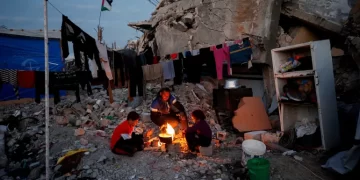
The effects of war in the Gaza Strip are no longer limited to the visible destruction above ground. They extend deeper and more dangerously—to the soil that produces food, the water that irrigates crops, and the food chain that sustains more than two million people.
A study by the Hebrew University and Israeli occupation institutions indicates that highly toxic military chemicals known as “forever chemicals” (PFAS) may have reached agricultural fields and water wells in areas surrounding the Gaza Strip. These substances were carried by wind currents from bombing debris over distances of up to 19 kilometers.
This raises a more urgent question: if areas outside Gaza were affected despite their distance from the explosions, what level of contamination exists inside the Strip itself, where thousands of tons of explosives fell directly on farmland, wells, and water sources?
The potential risks of PFAS accumulation and ammunition residues in Gaza’s soil and agricultural water threaten agricultural production, food security, and public health.
Environmental and agricultural expert Nizar Al-Wahidi describes PFAS as highly stable chemical compounds that do not break down easily and may persist in the environment for decades.
Their continued presence means a persistent environmental hazard, as they can accumulate over time and cause wide-ranging ecological damage, in addition to long-term health risks.
Intense bombardment and violent explosions have scattered hazardous chemical pollutants from munitions and their reactions, spreading them over wide areas due to blast force and air currents.
These pollutants settle first in the soil and are later transported by rainwater or irrigation systems into groundwater aquifers, turning them into a long-term source of contamination and a sustained threat to soil, water, and agriculture.
The damage is not limited to reduced soil fertility. It extends to the safety of agricultural production as a whole, as many of these substances are highly toxic and long-lasting in the environment.
Plants can absorb some of these pollutants through soil and water, allowing them to enter plant tissues and eventually the human food chain.
Prolonged exposure may be linked to health problems affecting the liver, kidneys, lungs, and nervous system, in addition to skin and respiratory conditions, especially in areas exposed to dust and contaminated particles from explosions.
Long-term exposure is also associated with digestive disorders, blood-related illnesses, and other chronic conditions, with risks increasing as pollutants accumulate in the environment.
Some researchers link rising rates of serious diseases, including cancer, to long-term exposure to war remnants and toxic substances, calling for specialized studies to determine the full environmental and health impact.
Military pollutants and explosion residues affect all crops, as plants naturally absorb nutrients and minerals through their roots—along with contaminants present in soil and water.
Leafy vegetables consumed fresh without cooking, such as mint, parsley, and arugula, are particularly vulnerable. Contamination is not limited to root absorption but also accumulates on leaves through airborne dust and particles.
This creates a dual exposure risk: pollutants inside the plant and on its surface.
Signs of chemically contaminated soil include abnormal changes in living organisms, including plants and animals, with potential long-term effects on human health.
One of the clearest indicators is declining soil fertility, reduced germination and growth rates, and in some cases, a complete loss of the soil’s ability to support plant life.
Even when crops grow, deformities may appear in fruits, leaves, or branches, reflecting a disrupted agricultural system affected by pollutants.
If studies show chemical contaminants reaching areas about 20 kilometers from Gaza, contamination inside the Strip is not a possibility but a near certainty, given the direct and repeated exposure to bombardment.
These findings highlight how the environmental consequences of war extend beyond visible destruction to soil, water, and food systems, carrying long-term risks to health and the environment.
Assessment of contamination requires extensive testing of soil, water, and crops for toxic substances, hazardous elements, chemical pollutants, and possible radioactive compounds.
Yet severe damage to laboratories, research centers, and universities limits the ability to conduct such analyses, obstructing a full scientific understanding of environmental damage.
Restoring contaminated land remains a complex process that begins with precise identification of pollutant types and levels.
Some forms of contamination, particularly those linked to long-lasting radioactive materials, may persist for thousands of years, making remediation extremely difficult.
Other chemical pollutants may be partially reduced through specialized methods, but this requires time, high costs, and advanced scientific infrastructure.
Continued pollution and environmental degradation are expected to reduce agricultural productivity and limit both the quantity and quality of crops compared to the past.
Alternative agricultural methods such as vertical farming, soilless cultivation, controlled environments, and urban agriculture may become necessary to sustain food production.
Agricultural losses are estimated to exceed 86% of the sector’s total components, with large areas of farmland destroyed, particularly east of Salah al-Din Street and north of Beit Lahia.
More than 94% of farmland has been bulldozed, leaving most green areas unusable.
Recovery and rehabilitation of the agricultural sector would require at least 3 billion dollars due to the scale of destruction affecting farmland, livestock, and infrastructure.
Shortlink for this post: https://daysofpalestine.ps/?p=75560