DaysofPal- The Gaza Center for Human Rights has expressed serious concern over growing indications of an undeclared and “soft” Israeli policy aimed at pushing Palestinians to leave the Gaza Strip.
The organization said that this is being done through opaque arrangements and opaque facilitation measures, all the while preventing critically ill patients from traveling for urgent medical care.
In a statement released Tuesday, the center said it had closely followed an announcement by the Israeli Coordinator of Government Activities indicating that around 44,000 people had left Gaza through various land crossings to third countries. By contrast, only about 2,000 individuals, primarily patients and their companions, were able to leave via the Rafah crossing.
The organization argued that this disparity highlights a troubling pattern: while patients face systematic obstruction and delays that have reportedly led to daily deaths among those awaiting treatment abroad, separate and unclear mechanisms are being used to facilitate the departure of individuals and families to third countries. These processes, it noted, lack defined criteria and are not subject to independent oversight.
Mounting Pressure on a Collapsing Health System
The center emphasized that approximately 18,000 patients and wounded individuals remain in urgent need of travel abroad for medical care. Thousands more require specialized treatment that is no longer available due to the collapse of Gaza’s healthcare system, which the organization attributes to ongoing military operations and a prolonged blockade.
It further warned that Israeli authorities continue to hinder patient travel through a complex system of administrative and security procedures. As a result, only a limited number of cases are approved each day, far below the scale required to address the growing medical emergency.
The Gaza Center for Human Rights stressed that freedom of movement and the right to travel are protected under international human rights law and must not be arbitrarily restricted. It argued that regulating this right through selective and non-transparent measures, particularly within the context of a devastating war and suffocating blockade, raises serious concerns that the policy may go beyond humanitarian considerations and instead aim to reshape the population reality under conditions of coercion and deprivation.
The statement also recalled that, in the early days of the military offensive on Gaza, Israel had publicly discussed the possibility of displacing the population outside the territory.
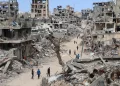
Today, the center said, widespread destruction of infrastructure, homes, hospitals, and basic services, combined with the confinement of residents to just 36 percent of Gaza’s total area, has created living conditions that are increasingly uninhabitable in both the short and long term. Under such circumstances, it argued, any claims of “humanitarian facilitation” for departure lose their moral and legal credibility.
“Not a Free Choice”
According to the center, leaving one’s homeland under conditions of insecurity, lack of shelter, and absence of medical care or employment cannot be considered a voluntary decision. Rather, it is the direct outcome of a coercive environment imposed by an occupying power.
It warned that creating living conditions that compel civilians to leave their land may constitute prohibited conduct under international humanitarian law and the Convention on the Prevention of Genocide, potentially amounting to forced displacement, even if presented under administrative procedures or travel arrangements to third countries.
The Gaza Center for Human Rights called for an immediate end to military operations and the lifting of the comprehensive blockade on Gaza, describing these as the root causes of the ongoing humanitarian crisis.
It also demanded that all patients and wounded individuals be granted prompt and safe access to travel for medical treatment without arbitrary restrictions or complex procedures.
In addition, the organization urged that any mechanism allowing people to leave Gaza be subject to clear, transparent standards and international supervision to ensure it is not used as a tool for depopulating the territory.
The statement concluded by calling on the international community to uphold its legal responsibilities to protect civilians, guarantee their right to remain on their land, and support the reconstruction of what has been destroyed.
It stressed that addressing Gaza’s humanitarian catastrophe should not involve opening pathways for migration under the pressure of war and blockade but rather tackling the root causes and enabling people to live in safety and dignity in their own homeland.
Shortlink for this post: https://daysofpalestine.ps/?p=74386