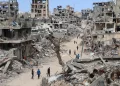
DaysofPal- Gazan Residents living along the eastern and northern edges of the Gaza Strip say they are enduring constant danger as gunfire, displacement, and infrastructure destruction shape daily life in areas near Israeli military positions.
Witnesses describe conditions as resembling an “open shooting range,” with sniper fire and military activity reaching deep into residential neighborhoods. Mohammed Mansour, a resident of Al-Bureij Refugee Camp, said the shooting is continuous and does not distinguish between civilians.
“We live with the feeling that we are targets at any moment,” he said. “Gunfire reaches the center of the camp, coming from snipers, vehicles, and even aircraft. There is no safe time during the day.”
Accounts from multiple areas indicate that the violence is not only causing casualties but also forcing repeated displacement.
In eastern Deir al-Balah, resident Ibrahim Salim said ceasefire arrangements have not improved conditions.
“We are told to leave our homes, but the message comes through bullets, not warnings,” he said.
“I have been displaced more than ten times, and each time we return, the shooting resumes.” He added.
Residents also report direct targeting of homes. Salim said his house was struck with incendiary and explosive rounds, leading to its destruction and preventing his family from returning.
Essential services have also come under strain. In Al-Maghazi Refugee Camp, Zakaria al-Mansi said water tanks and solar panels are repeatedly targeted.
“Heavy gunfire destroyed the water tanks and solar energy systems,” he said. “Every morning, new tanks are hit. It has become like a daily shooting practice, and it puts children and women at serious risk.”
Aid sources and analysts say the situation has been compounded by the expansion of Israeli-controlled areas.
New demarcations, referred to locally as the “yellow line” and the recently introduced “orange line”, have significantly reduced the space available for civilians.
According to estimates cited by researchers, Israeli forces now exercise control over at least 64% of Gaza’s total area, with additional restricted zones surrounding large portions of the territory.
Jad Isaac, director of the Applied Research Institute – Jerusalem, said the developments are pushing residents into increasingly smaller and less viable areas.
“This means concentrating as many Palestinians as possible into the smallest space possible,” he said, warning that the remaining areas lack the resources needed for sustainable living.
Analysts link the developments on the ground to broader political dynamics. Writer and Israeli affairs specialist Adel Yassin said the measures may reflect attempts to avoid deeper commitments tied to ceasefire agreements, particularly regarding withdrawal.
“Any withdrawal would be politically costly,” he said, referring to Israeli Prime Minister Benjamin Netanyahu. “Scenes of troop pullbacks could significantly impact his political standing.”
Yassin added that continued civilian presence in these areas undermines narratives of military success and complicates proposals aimed at reshaping Gaza’s demographic landscape.
The situation has raised growing humanitarian concerns, with shrinking living spaces, damaged infrastructure, and repeated displacement placing immense pressure on civilians.
Local voices and analysts warn that without intervention, the current trajectory could further deepen the crisis, as residents remain caught between ongoing security operations and the struggle to maintain basic living conditions.
Shortlink for this post: https://daysofpalestine.ps/?p=74373