Beirut – More than half a million people across Lebanon have been forced from their homes as Israel dramatically escalates its military attacks on the country, pushing communities into yet another humanitarian crisis in a region already shattered by war.
Lebanon’s Social Affairs Minister, Haneen Sayed, announced on Sunday that 517,000 people have registered as displaced since renewed fighting erupted earlier this week.
Of those, more than 117,000 are now crammed into government-run shelters, many of them schools and public buildings struggling to accommodate the growing number of families fleeing Israeli strikes.
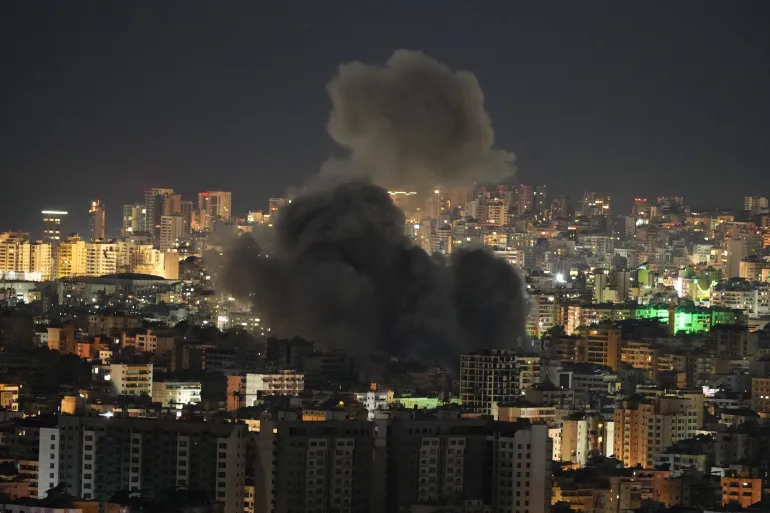
The surge in displacement comes as Israel widens its air and ground campaign across Lebanon, bringing the war directly into the heart of the capital, Beirut.
Israeli Strike Hits Central Beirut
In a major escalation, an Israeli drone struck a hotel room in the seaside district of Raouche early Sunday morning — an area known for its waterfront promenade and one that had previously been spared during earlier rounds of fighting.
The neighbourhood had recently become a refuge for Lebanese families who had fled Israeli bombardment in southern and eastern parts of the country.
According to the Lebanese Ministry of Public Health, at least four people were killed and ten others wounded in the attack.
Israel claimed the strike targeted senior commanders from Iran’s Quds Force, part of the Islamic Revolutionary Guard Corps, alleging they were planning attacks against Israel.
For Lebanese residents, however, the bombing marked a frightening expansion of the war into civilian spaces where displaced families had believed they might find safety.
A Rising Civilian Toll
Over the past week alone, 394 people have been killed across Lebanon, according to the health ministry.
Among the dead are:
-
83 children
-
42 women
-
9 rescue workers
Entire communities in southern Lebanon and the Bekaa Valley have been forced to flee under relentless bombardment.
Families have packed what little they could carry and rushed north toward Beirut and other cities, seeking shelter wherever space remains.
Fighting Spreads Along the Border
Meanwhile, the Israeli military confirmed the deaths of two soldiers during fighting in southern Lebanon — the first Israeli fatalities since hostilities resumed.
One of the soldiers was identified as Maher Khatar, a 38-year-old master sergeant from the Druze town of Majdal Shams.
Israeli ground forces have begun pushing deeper into southern Lebanon, seizing elevated positions near the border while tanks and armoured bulldozers mass along the frontier.
The build-up has fuelled growing fears of a full-scale Israeli invasion of Lebanon.
Hezbollah Continues Cross-Border Attacks
The Lebanese group Hezbollah has continued launching rockets and drones toward northern Israel, saying its fighters are engaged in clashes with Israeli troops near the border town of Aitaroun.
According to regional reporting, missiles have reached as far as the Israeli cities of Nahariya and Haifa, a strategic port city that hosts major military and intelligence facilities.
The renewed conflict erupted after Israeli and US air strikes killed Iran’s Supreme Leader, Ali Khamenei, prompting retaliatory attacks from Hezbollah against Israel.
Lebanon Warns of Catastrophic Consequences
Lebanon’s prime minister, Nawaf Salam, warned that the country has been pulled into a devastating conflict that threatens to overwhelm its fragile infrastructure and economy.
“Our country has been drawn into a devastating war that we did not seek and did not choose,” he said.
He cautioned that the scale of displacement now unfolding could trigger “unprecedented humanitarian and political consequences.”
A Growing Regional Crisis
Israel says it has killed around 200 Hezbollah fighters since the escalation began, though the group has not confirmed its own losses.
But beyond the battlefield statistics, the war is once again displacing hundreds of thousands of civilians — families who have been forced to abandon their homes and livelihoods with no certainty of when, or if, they will be able to return.
For many in Lebanon, the fear is that the current escalation is only the beginning.
Shortlink for this post: https://daysofpalestine.ps/?p=72840