DaysofPal- The Gaza Center for Human Rights (GCHR) has expressed deep concern over growing indications surrounding mechanisms for reopening the Rafah border crossing between Gaza and Egypt, warning that accompanying Israeli restrictions and security conditions undermine the core right to freedom of movement.
In a statement issued Thursday, the center said the right to travel and return is a fundamental human right guaranteed under international human rights law and must not be subjected to arbitrary procedures or political and security considerations that strip it of its meaning.
GCHR stressed that restrictions on travel are permissible only in the narrowest circumstances, must meet strict necessity standards, and cannot involve discrimination or collective punishment.
Within this context, the center emphasized that patients and the wounded are entitled to special protection. Enabling them to leave Gaza for medical treatment, it said, is an urgent humanitarian right that must not be delayed or tied to security arrangements or numerical calculations related to arrivals and departures.
The rights group warned that imposing security conditions, limiting traveler numbers, or enforcing unequal formulas between those entering and leaving would deprive thousands of Palestinians of their right to travel. Such measures, it said, would transform Rafah from a civilian humanitarian crossing into a tool of pressure and population engineering, in clear violation of the prohibition on forcible transfer under international humanitarian law.
Against this backdrop, GCHR said it is closely monitoring alarming revelations by a retired Israeli general advising the Israeli army about plans to establish a large camp in southern Gaza, specifically in Rafah. The proposed camp would reportedly be placed under strict Israeli security control, equipped with advanced surveillance and facial recognition technologies, and linked to a limited reopening of the Rafah crossing.
According to the center, the camp would be used to house Palestinians seeking to leave Gaza via Egypt or those effectively forced to remain inside a heavily monitored zone.
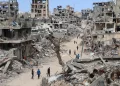
GCHR said these proposals, combined with indications that Israel seeks to ensure the number of departures exceeds returns, represent a dangerous extension of rejected transfer plans. The center warned that Rafah is being instrumentalized to reshape Gaza’s population, particularly after Israeli forces have spent more than two years rendering the Strip uninhabitable through systematic acts of genocide, including mass killings, widespread destruction, starvation, dehydration, and denial of medical care.
The center also cautioned that continued closure of the crossing to patients and wounded individuals, or the imposition of restrictive travel conditions, is pushing their health conditions to life-threatening levels.
Data from the Ministry of Health, GCHR said, indicate that around 20,000 patients with completed medical referrals are awaiting permission to travel for treatment abroad amid severe shortages of medicines, medical supplies, and the collapse of most specialized health services following extensive damage to health infrastructure.
According to available figures, 440 cases are classified as urgent life-saving emergencies, while 1,268 patients have died while waiting to travel for treatment—an indicator, the center said, of the devastating human cost of the closure policy.
Cancer patients are among the most severely affected groups, with nearly 4,000 cases on urgent waiting lists, as Gaza lacks specialized treatments and diagnostic services. Referral lists also include around 4,500 children, while only 3,100 patients have been able to leave Gaza since the Rafah crossing was closed on May 7, 2024.
GCHR warned that these figures, which the Ministry of Health has described as extremely dangerous, point to unpredictable health consequences, including further rises in patient deaths and unprecedented expansion of referral waiting lists, in the absence of any viable domestic alternatives.
The center firmly rejected any requirement that travelers’ names be subjected to Israeli security screening, whether upon departure or return. Such a mechanism, it said, constitutes a grave violation of the right to freedom of movement and turns travel into a conditional privilege subject to the approval of an occupying power with no legal authority over civilian crossings or population movement.
GCHR warned that adopting such procedures would effectively deprive tens of thousands of Palestinians of their right to travel and deter thousands more—including patients and life-saving cases—from attempting to leave for fear of arrest, detention, or enforced disappearance. This, it said, amounts to the use of security measures as collective punishment and political pressure, in blatant violation of international humanitarian and human rights law, which prohibit discrimination and indirect threats to life and bodily integrity.
In conclusion, the Gaza Center for Human Rights said the full and regular reopening of the Rafah crossing, the facilitation of travel—especially for patients and the wounded—without arbitrary restrictions, and the smooth entry of medical supplies and essential medicines represent the last remaining lifeline for thousands of patients in Gaza.
The center stressed that any arrangements governing the crossing must be strictly civilian and humanitarian in nature, fully detached from occupation policies and security or demographic objectives, and must ensure respect for fundamental rights, foremost among them the right to life, dignity, and freedom of movement.
Shortlink for this post: https://daysofpalestine.ps/?p=71750