
In 1847, Ireland was engulfed in a famine that would kill more than one million people and force another two million into exile. As hunger tore through the countryside, carts laden with food travelled under heavy British military guard. Twenty-five soldiers and armed police escorted convoys through villages where people were starving, weapons drawn and ready. An eyewitness journalist described “bullets, bayonets and cavalry swords” protecting supplies as they passed communities reduced to skin and bone.
These scenes were not exceptional. Food, much of it destined for export, routinely moved through towns and hamlets whose inhabitants were described by contemporaries as skeletal. Despite later portrayals of stoic resignation, the Irish did not quietly accept starvation. As An Gorta Mór, the Great Hunger, reached its peak in 1847, food riots spread. Mills, bakeries and meal shops were raided, livestock stolen, and carts and cargo boats seized. Those caught faced the absurd charge of “plundering provisions”. Some judges recognised the reality: these were not criminals, but starving people acting out of necessity, resistance and survival.
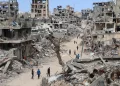
Nearly two centuries later, the swords and bayonets are gone. But in Gaza, food is still withheld — now enforced by drones, sniper fire and an encircling siege. The machinery has changed, but the core weapon has not. Dehumanisation remains the foundation that makes such suffering possible.
What happened in Ireland, and what is happening in Palestine, could not occur without first stripping people of their humanity. When a population is portrayed as inferior, violent, or undeserving of life itself, almost any cruelty can be justified. That same logic underpins Israel’s ongoing starvation of Gaza, despite its agreement to a ceasefire last October that included commitments to allow sufficient food and aid into the besieged territory.
Although the UN-backed Integrated Food Security Phase Classification lifted its formal famine designation last month, Israel continues to block adequate supplies. Palestinians remain hungry, and now babies are dying from cold and deprivation.
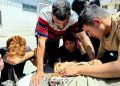
This must be stated plainly: Palestinian babies are freezing to death.
In December, two-week-old Mohammed Khalil Abu al-Khair died of acute hypothermia. Eight-month-old Rahaf Abu Jazar died soon after from exposure. Just weeks ago, two-month-old Arkan Firas Musleh also froze to death. Had these children been Israeli, British or American — had they been white, had they not been Palestinian — their names would have dominated headlines worldwide. Instead, their deaths passed largely unnoticed.
This silence is not accidental. Anyone who has watched Western coverage of Israel’s assault on Gaza over the past two years will recognise the pattern. And now, as the world responds with indifference to dying infants, Israel has announced a ban on 37 aid organisations operating in Gaza, tightening the siege even further.
The racism that renders some lives disposable is not spontaneous. It is built carefully over decades, even centuries, and then exploited when useful to those in power. The Irish and Palestinians are far from the only victims of this process.
During the 1944 Bengal famine, Winston Churchill reportedly dismissed calls for aid, claiming relief would be pointless because Indians “breed like rabbits”. In Ireland, Charles Trevelyan, the British official overseeing famine relief, spoke openly of his contempt for the Irish. He framed the famine as an act of divine providence and insisted that helping too much would interfere with the free market and the principles of laissez-faire economics. The Irish poor, he claimed, were indolent, barbaric, and incapable of self-improvement — ignoring Britain’s central role in creating their dependency.
Some even argued that any financial aid would be misused, claiming the Irish would prioritise rebellion over feeding their children. It is a familiar accusation, echoed today in claims that Palestinians are responsible for their own suffering.
As in Gaza now, a compliant media played a crucial role. While some early coverage of the Irish famine was sympathetic, much of it blamed the victims. The Economist declared in 1846 that Irish suffering was the result of “wickedness and folly”. The London Times opposed government-funded aid. Punch magazine caricatured the Irish as ape-like parasites draining England’s resources.
The parallels with contemporary coverage of Gaza are striking. The same narratives appear in major outlets today, reinforced by familiar refrains: Palestinians should have known better; Hamas is to blame; children are used as shields. These talking points function not to explain reality, but to excuse atrocity.
One million Irish people died of hunger. Palestinians are enduring a live-streamed genocide. Babies freeze to death. Children are buried beneath rubble. These are not accidents of history. They are the result of deliberate decisions made by those in power — and sustained by enablers, whether 19th-century British elites or Israel’s modern Western allies.
In 1997, Tony Blair acknowledged that “those who governed in London” had failed the Irish people. It was a hollow admission, delivered 150 years too late for the dead, the displaced, and a nation still shaped by that trauma.
Gaza’s catastrophe, slower and more grinding, is still unfolding. Families shiver in tents. People go hungry. Infants die. The United Nations says it has enough food, medicine and shelter for hundreds of thousands — but Israel will not allow it in.
If global media continue to ignore children like Mohammed, Rahaf and Arkan, while amplifying official Israeli narratives; if Western governments continue to arm, fund and protect Israel while Palestinian lives are treated as expendable, the death toll will only grow.
The Irish famine showed what happens when starvation is allowed to run its course. Gaza now poses a stark question to the world: have we learned anything at all — or are some lives, even now, still considered too cheap to save?
Shortlink for this post: https://daysofpalestine.ps/?p=71238