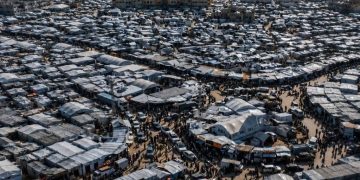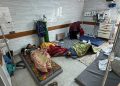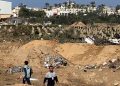

DaysofPal- In a harrowing scene that starkly exposes the humanitarian crisis gripping Gaza, thousands of desperate Palestinians swarmed a Gaza Humanitarian Foundation (GHF) aid distribution center in Rafah on May 26, triggering chaos that ended in bloodshed. Israeli occupation forces responded to the mass gathering with gunfire, initially into the air, then reportedly at civilians, leaving ten Palestinians dead and at least 62 injured, according to Gaza’s Government Media Office.
On May 31, the tragedy deepened. Sources at Nasser Medical Complex confirmed that four more Palestinians were killed by Israeli occupation forces while attempting to reach the American company’s aid center west of Rafah. These deaths raise further alarm about the conduct and intent behind the militarized aid effort.
Israel continued its aerial attacks across the Strip earlier that day. Two Palestinians were killed in an Israeli drone strike targeting the town of Bani Suhaila, east of Khan Yunis. In a separate attack, another was killed and one injured in an airstrike on the al-Sikka area in Gaza City’s center.
The aid center, backed by the United States and Israel, was established as part of a controversial initiative that bypasses the United Nations and operates under Israeli military supervision. Critics say that in addition to lacking neutrality, the initiative serves as a strategic weapon of war, employing aid as pressure and leverage.
“There was no trace of humanity in what happened,” said Jehad Al-Assar, a Rafah resident who walked for over 90 minutes to reach the center. “The crowd nearly crushed me. Foreign armed forces stood by and did nothing.”
Weaponizing aid: A “facade for violence and displacement”
International condemnation quickly followed. Thomas Fletcher, the UN’s top humanitarian official, denounced the program as a “facade for further violence and displacement,” accusing it of tying aid delivery to Israel’s political and security demands. Another UN official bluntly described the plan as “weaponizing aid.”
On May 25, one day before the chaos, GHF Executive Director Jake Wood resigned, citing the impossibility of upholding humanitarian principles under current conditions. “I will not be part of a plan that entails the forced displacement of Palestinians,” Wood said, urging Israel to open all crossings for unrestricted humanitarian access.
Stephane Dujarric, spokesperson for UN Secretary-General António Guterres, expressed horror at the violence:
“The images and videos from the GHF aid points are heartbreaking, to say the least… We and our partners have a detailed, principled, operationally sound plan supported by member states to get aid to a desperate population.”
Mass displacement and a manufactured famine
The Gaza Strip has been under Israeli siege for over 600 days. Since October 7, 2023, Israel has methodically blocked aid, destroyed agricultural infrastructure, and bombed food storage facilities, pushing the enclave of 2.4 million people into catastrophic levels of hunger.
The GHF initiative has drawn particular ire for forcing civilians to pass through Israeli military checkpoints and identity checks, with food distribution guarded by armed foreign contractors. The Washington Post called the plan a dangerous militarization of aid delivery that “portends more chaos and shooting.”
Amjad Shawa, director of the Gaza NGO Network, told Al Jazeera that only the UN has the capacity and credibility to deliver aid safely and equitably.
“The goal of establishing military aid points is to pressure the residents of northern Gaza to migrate south,” he said.
The Israeli military is still pursuing its campaign of annexation and devastation of territory. On May 31, the Hebrew outlet Walla cited Israeli army sources claiming control over large parts of Khan Younis, stating that areas are being deliberately “emptied of civilians” and infrastructure destroyed to prevent return.
A starvation campaign as a tool of war
The UN Special Rapporteur on the Right to Food warned this week that Gaza is entering a new and dangerous phase of its starvation crisis, calling it a “deliberate campaign of genocide” in flagrant violation of international law.
Since early March, Israel has effectively sealed off the Strip, cutting off even basic humanitarian aid, particularly food, to Gaza’s north. The Israeli strategy appears designed to engineer mass displacement, using hunger as a lever of control.
The Government Media Office in Gaza described the events in Rafah as “a deliberate massacre and a full-fledged war crime, committed in cold blood against civilians weakened by over 90 days of siege-induced starvation.”
Shortlink for this post: https://daysofpalestine.ps/?p=63418