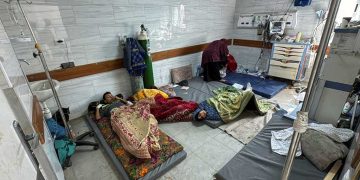
DayofPal– A controversial U.S.-backed aid distribution plan faces mounting refusal and logistical challenges just one day before its scheduled implementation at a time the humanitarian crisis deepens for more than 2.4 million residents of the Gaza Strip.
The plan, spearheaded by the American nonprofit “Gaza Relief Foundation” and led by a former U.S. Marine, proposes a distribution system tightly controlled by Israel and secured by private American security firms. However, the plan is encountering serious opposition, particularly from the United Nations and major humanitarian organizations.
According to reports from Zman Israel, three major obstacles threaten the viability of this aid model:
No Humanitarian Experience
The plan relies on two private firms, Safe Reach Solutions and U.G. Solutions, both run by former U.S. military and CIA officers, and lacking any significant background in humanitarian work or knowledge of the Palestinian context.
The involvement of executives formerly associated with Blackwater has raised concerns among relief agencies, many of which have declined to participate. Notably, Safe Reach Solutions has reportedly advertised positions on LinkedIn for “humanitarian liaison officers” to bridge operations with the aid sector.
Unclear Funding
The Gaza Relief Foundation has yet to clarify how it will fund its operations, including the procurement of food and the payment of contractors.
Israeli media revealed attempts to broker deals with Israeli companies to supply the aid material, prompting fears that the plan is blending humanitarian assistance with commercial gains for the Israeli occupation.
Observers warn that this could compromise the neutrality of the aid effort.
Israeli Finance Minister Bezalel Smotrich has stated that only minimal aid will be allowed into Gaza, a move experts warn could lead to inflated prices and widespread theft.
A 20-kilogram food box meant to support a family for a week could become a highly coveted commodity.
One senior Israeli diplomat acknowledged that Gaza residents carrying aid over long distances could be at risk of robbery.
The plan to draw tens of thousands of people into queues each day was described as “insane and unfeasible.”
Widespread Criticism from UN
UN humanitarian official Tom Fletcher criticized the aid model as a “cruel sideshow” during a recent Security Council session.
He warned that placing distribution centers only in southern and central Gaza could be seen as advancing Israel’s objective of depopulating the north.
Fletcher emphasized that the proposed model would not only exclude vital areas from receiving aid but also make humanitarian assistance conditional on political and military goals, effectively using hunger as a bargaining tool.
The Washington Post reported that this plan could severely limit the operational capacity of established UN agencies and international relief groups in Gaza.
Many organizations adhere strictly to principles of impartiality and independence, avoiding involvement with armed entities. Representatives from 10 major humanitarian organizations told the newspaper that limiting distribution to select southern locations would be discriminatory and could provoke further displacement.
UN Secretary-General António Guterres reaffirmed that the organization would not support a plan that disregards core humanitarian principles.
The Office for the Coordination of Humanitarian Affairs stated that both the Secretary-General and the Emergency Relief Coordinator have pledged not to participate in any initiative that lacks neutrality or independence.
The UN urged global leaders to push for an end to the blockade and enable unrestricted aid entry.
“Our teams remain on the ground in Gaza, ready to scale up deliveries as soon as the blockade is lifted,” the office stated. “We have significant stocks of vital supplies waiting for entry.”
Shortlink for this post: https://daysofpalestine.ps/?p=63212