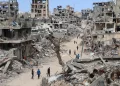
DaysofPal — The once-vibrant Netzarim Martyrs’ Junction, a critical artery connecting the northern and southern parts of the Gaza Strip, now stands as a grim testament to the devastation wrought by Israel’s military offensive against Palestinian civilians.
Scenes of widespread destruction reveal the extent of the brutality inflicted upon this densely populated area, where infrastructure, homes, and vital facilities have been reduced to rubble.
A Lifeline Turned into a Corridor of Pain
What was once a bustling hub of movement and trade has transformed into a corridor of suffering. Along the junction, demolished houses, scorched agricultural lands, and shattered water and sewage networks paint a bleak picture of life in post-conflict Gaza. Residents comb through the debris, searching for remnants of their former lives amidst the ruins of what they once called home.
“The occupation did not stop at targeting homes,” said Hajj Abu Mahmoud, a 70-year-old man whose house lies in ruins. “It left thousands of deep craters that destroyed farmland and rendered fertile soil unusable, plunging landowners into an economic and food crisis.” Agricultural fields, which sustained families for generations, are now barren wastelands, erasing livelihoods and exacerbating food insecurity.
Targeting Education and Infrastructure
Educational institutions, schools, and community centers were also targeted during the onslaught, leaving behind a generation deprived of its right to education. The destruction of these establishments represents a deliberate attempt to undermine the cultural and intellectual fabric of Gaza.
Water and sewage systems, already fragile before the conflict, were obliterated by relentless bombing. This catastrophic damage poses a severe humanitarian threat, with potential outbreaks of disease looming over thousands of residents who rely on these essential services daily.
Life Amidst Ruins
Residents navigate treacherous roads riddled with potholes and collapses, forced onto narrow detours controlled by military checkpoints. At one such checkpoint, foreign security personnel—Egyptian and Qatari forces—monitor every movement, adding another layer of restriction to the lives of those trying to rebuild.
In the heart of this desolation, fortified military structures loom large, symbolizing the continued presence of occupation even after the fighting subsides. These imposing concrete barriers serve as constant reminders of the oppressive reality faced by Gazans.
Voices from the Rubble
For many, the emotional toll runs deeper than physical loss. Umm Sami, sifting through dusty remnants of her belongings, expressed her anguish: “These aren’t just clothes; they’re memories—an entire life buried under the rubble. The occupation didn’t just destroy buildings; it sought to erase our identity.”
Younger voices echo similar sentiments. Salim Al-Namrouti, reflecting on the broader implications of the destruction, noted, “This wasn’t random shelling—it was systematic targeting of infrastructure. Roads weren’t merely damaged but pulverized beyond recognition, meaning reconstruction will take years, not months.”
The economic impact is equally devastating. The Martyrs’ Junction, once a vital trade route, now lies in disarray, causing significant financial losses for businesses dependent on it. “Turning this road into rubble isn’t just about destroying infrastructure—it’s about crippling the Palestinian economy,” Salim added, highlighting the long-term consequences of the assault.
A City Struggling to Survive
As Gaza grapples with the aftermath of war, its people remain resilient despite overwhelming challenges. Yet, the scars of destruction run deep, both physically and emotionally. With each passing day, the struggle intensifies—to rebuild, to recover, and to endure.
The story of Netzarim serves as a stark reminder of the human cost of conflict and the urgent need for international attention and action. As the world watches, the people of Gaza continue to fight for survival, steadfastness, and hope in the face of unimaginable adversity.
Shortlink for this post: https://daysofpalestine.ps/?p=60591