“Invention is the mother of necessity.” This Arabic adage has never been more relevant for the people of Gaza, where survival under the ongoing blockade and constant bombardment has forced many to create new professions.
As Israel continues to close Gaza’s borders and restrict vital supplies, Gazans are innovating ways to support their families in the face of daily destruction.
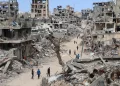
A year ago, the Israeli occupation launched one of its most aggressive attacks on Gaza, wreaking havoc across every sector of life.
Despite the devastation, Gazans chose to remain, surviving with whatever limited resources they had. Their resilience reflects their deep connection to their land.
Charging Stations
In the streets and displacement camps of Gaza, new professions have emerged—like charging mobile phones and batteries, and selling chilled drinks. Many of these entrepreneurs rely on alternative energy sources, charging a small fee for their services.
These businesses arose after the only power station in Gaza was destroyed and fuel supplies were blocked at the start of the war.
Abdul Rahman al-Hawajri, who lost his job grinding flour nine months ago, found refuge in a displacement camp in Deir al-Balah. Unable to return to his home due to incessant Israeli bombardment, he launched a mobile charging station.
Al-Hawajri explained that the demand for charging services surged as electricity outages left many without a way to communicate or power basic devices.
“I charge phones for one shekel and batteries for three,” he said, expressing his hope that the war would end soon, allowing everyone to return home.
Similarly, Noor al-Hawajri started a business cooling water bottles for displaced families during the sweltering summer heat. “I used to work in construction,” he shared, “but with the war shutting down most work sectors, I had to adapt. Now, I sell cold water for one shekel per bottle.”
Repairing Damaged Currency
Another emerging profession involves repairing damaged coins and banknotes, ensuring they can still be used in Gaza’s markets. Yasser Abu Harbid, a displaced man from Beit Hanoun, took up this trade after Israeli blockades prevented the entry of new currency, causing a shortage of usable money in Gaza.
Abu Harbid shared how he stumbled into the job: “After witnessing a dispute over a torn banknote, I fixed it to settle the argument.
That’s when I realized this could become a business.” Now, he repairs worn currency for a small fee, using adhesive to reinforce old notes.
Selling Firewood
With cooking gas and fuel in short supply, selling firewood has become another essential trade in Gaza. What used to be a winter-only job has now become a year-round necessity, as more families rely on firewood for cooking.
Ibrahim Saeed, 77, used to be a farmer in northern Gaza, but relentless bombing destroyed his land. Now displaced, Saeed gathers and sells firewood, which has become a lifeline for many households. “One kilogram of wood now sells for two shekels,” Saeed said, emphasizing how firewood has become a substitute for cooking gas.
Mud Ovens
The scarcity of cooking gas and the closure of many bakeries have led to the revival of mud ovens. These traditional ovens, once rarely used, are now a common sight across Gaza’s displacement camps, where families cook and bake with the few resources they have left.
Fatima, a woman displaced multiple times since the war began, built her own mud oven in central Gaza to cook for her family. Over time, as conditions worsened, she turned it into a small business, offering to bake for other families in exchange for a modest fee.
“Now, we bake not only bread but also cook meals and heat water, especially as winter approaches,” she said, describing how women gather around her oven to share stories of survival.
Bicycle-Powered Sewing Machines
Some Gazans have even found ways to overcome power outages by using manual labor. Tailors like Maher Khalil have adapted their sewing machines to run on bicycle power. “We couldn’t sit idle,” Khalil explained. “I attached my sewing machine to a bicycle, so now we can keep working.”
This innovation allows Khalil and his helpers to continue repairing clothes, with a young relative pedaling the bike to power the machine.
“We earn 15 to 20 shekels a day, focusing on mending old clothes since no one can afford new ones,” he added.
Cobbling Shoes
The war has also led to a revival in cobbling. With new shoes scarce and expensive, many Gazans are turning to cobblers like Abdul Karim Abu Attaya to repair and reuse their worn-out footwear.
“Shoes are so expensive now, some as much as 200 shekels,” Abu Attaya said. “People would rather patch up their old shoes than go barefoot.”
Without electricity or fuel, Abu Attaya relies on traditional tools—hammers, nails, and glue—to repair shoes. Despite the challenges, he and his team work tirelessly, earning a small fee of five to eight shekels per repair.
As Gaza endures another year of brutal siege and war, its people continue to demonstrate extraordinary resilience. Each new trade is a testament to their spirit, their determination to survive, and their unshakable bond to their land.
From selling firewood to repairing worn currency, Gazans have found creative ways to persevere, despite living under some of the most challenging conditions in modern history.
Shortlink for this post: https://daysofpalestine.ps/?p=57748